Mon – Sat: 9:00 AM – 7:00 PM IST

Order Fulfillment Software for brands who ship their own

From the moment a customer pays to the moment the parcel is signed for — and back again when it is returned.

Taking the order is the easy part. Fulfilment is the promise you made at checkout, kept by a warehouse, a carrier and a returns desk that all have to agree. This page is about running that yourself: orchestrating orders from every channel, allocating stock you can actually ship, and surviving November.

Free Proof of Concept Works with your existing carriers Source code available on our own products
The promise

The order is easy. The promise is the hard part.

Checkout is a commitment made on your behalf by software, to a customer you have not met, about stock you have not yet touched and a carrier you do not control. Everything after that is the work of keeping it. Fulfilment software exists to make that promise survivable at volume: to know what can genuinely be shipped, to get it to the right bench in the right sequence, and to tell the customer the truth while it happens.

  • One availability number, not one per sales channel
  • Allocation at the moment of order, not at the moment of pick
  • A pick sequence that reflects your racking, not your SKU codes
  • A carrier choice made on service and cost together, per parcel
  • A returns path designed before the first return arrives

Every failure below is a version of the same thing: a promise made by one system that another system could not keep.

Failure points

Six places an order actually goes wrong

In roughly the order they occur, and roughly the order of how expensive they are to fix later.

The stock was never there

Channel stock figures drifted from reality. The customer paid, the pick failed, and you are now choosing between a split shipment and a refund.

Allocated, but to the wrong place

The order was assigned to a location that could not ship it in time. Correct on paper, late in practice.

Picked, then stuck

The pack bench is the bottleneck nobody measures. Pickers race; cartons queue; the carrier cut-off passes.

Wrong box, wrong rate

Cartonisation decided by eye rather than by rule. The dimensional weight surcharge turns a profitable order into a flat one.

Label printed, parcel not scanned

The manifest says it shipped. The carrier never had it. This is the single most common cause of a tracking page that says nothing for two days.

Returned into limbo

The parcel arrives back, is signed for, and sits. Until it is inspected and dispositioned it is neither stock nor a refund, and the customer is waiting.

Orchestration

Where orders come from, and how they get allocated

Accept from every channel on the same terms

Your own storefront, marketplaces, wholesale purchase orders, EDI, phone and a spreadsheet somebody still emails. They arrive in different shapes and must become one order record with one set of rules, or you end up with per-channel exceptions that nobody can reason about.

Decide availability once

Available to promise is physical stock, minus what is already allocated, minus safety stock, plus confirmed inbound within a horizon you choose. Compute it centrally and broadcast it. Letting each channel maintain its own version is how overselling starts.

Allocate with intent

Which location, which batch, which expiry. Nearest to the customer is not always right: shipping from the site that can meet the cut-off usually beats shipping from the closest one. FEFO matters wherever shelf life does.

Split only when it pays

Splitting an order doubles the freight and halves the customer's patience. The rule should be explicit and reviewable: split when the delay exceeds a threshold, otherwise hold and ship complete, and tell the customer which you chose.

The floor

Pick, pack, ship — the hour that decides the day

Picking that follows the racking

A pick list ordered by location rather than by line number removes walking that nobody budgets for. On a mixed-SKU floor this is usually the largest single productivity gain available, and it costs nothing but sequencing.

Cartonisation as a rule, not a guess

Dimensions and weight per SKU, a carton library, and a rule that chooses. Packers stop deciding and start packing, and your dimensional-weight surcharges become predictable.

Scan-verified packing

Scanning each item into the carton catches the mispick before it becomes a return. It adds seconds per order and removes the most expensive error category you have.

Label at the bench, manifest on time

Rates and service levels pulled live, label printed at the point of pack, and a manifest that closes before the driver arrives rather than after.

Carriers

Choosing the carrier per parcel, not per contract

Most brands pick a carrier once a year. The saving is in picking one per order.

Rate shop within the promiseCompare live rates across your accounts, but only among services that still meet the delivery date you sold. Cheapest is only cheapest if it arrives on time.
Know your surcharge profileResidential, remote area, fuel, oversize, Saturday. These are where a quoted rate and an invoiced rate diverge, and they are knowable in advance.
Address quality before dispatchValidating and correcting addresses at the point of order costs a fraction of a redelivery, and almost nothing compared with a parcel returned to sender.
Proactive trackingWatch for parcels that stop moving and tell the customer before they ask. Most 'where is my order' contacts are avoidable with one notification.
Returns

The half of fulfilment nobody budgets for

A return is a fulfilment order running backwards, with worse data and a less patient customer. The thing that separates a returns process that works from one that does not is the inspection decision, and whether a rule makes it or a person does. Written rules make the same call every time, are auditable afterwards, and let the refund issue the moment the disposition is recorded rather than days later.

  • Authorise before despatch so you know what is arriving and why
  • Scan on receipt against the original order, not against a paper note
  • Disposition by rule: resaleable, refurbish, liquidate, scrap
  • Return good stock to available immediately — it is often your fastest-moving inventory
  • Feed reason codes back to merchandising, because repeat returns are a product problem

Returns rate is a merchandising metric. Returns cycle time is a fulfilment one, and it is the one customers feel.

Peak

What actually breaks in November

Peak does not create new problems. It removes the slack that was hiding the existing ones.

Integrations, not pick rate

Marketplaces push harder than they do in June. The acknowledgement queue backs up, orders arrive late to the floor, and the warehouse is blamed for a problem that happened upstream.

Temporary staff and tribal knowledge

Processes that rely on experienced pickers knowing where things live collapse when half the floor is new. Directed picking is what makes an agency worker productive on day one.

Carrier capacity, not carrier rates

Cut-offs tighten and collections slip. Having a second account configured and tested in September is worth more than a better rate card.

The returns wave in January

Peak's bill arrives six weeks later. Staffing the returns desk for it is the difference between recovering stock and discounting it.

The modules

All 71 modules, and which ones matter when the stock is yours

The complete feature set, grouped by function. A brand shipping its own orders uses most of this and can ignore some of it — the note on each group says which, and why.

Control Tower (6)

The daily view a despatch manager lives in, and the four numbers a board asks for.

  • Control Tower
  • Alerts
  • Order Accuracy
  • Fulfillment Speed
  • Space Utilisation
  • Client Profitability

Inbound (6)

Receiving is where tomorrow’s availability is decided. Get it wrong and allocation inherits the error.

  • Advance Shipping Notices
  • Goods Receipts
  • Putaway
  • Dock Schedule
  • Gate Passes
  • Customs

Inventory (8)

The figure you sell against. Everything downstream is only as good as this.

  • Stock on Hand
  • Stock Ledger
  • Stock Adjustment
  • Cycle Counts
  • Pallets
  • Serial Numbers
  • Scanning
  • Barcodes

Outbound & Order Fulfillment (9)

The core of this page: acceptance through to a scanned parcel.

  • Orders
  • Allocation
  • Pick Planner
  • Pick Lists
  • Packing
  • Shipments
  • Manifests
  • Rate Shopping
  • Value-Added Work

Returns & Kitting (2)

Returns are fulfilment in reverse, and bundles are made here rather than bought.

  • Returns
  • Kits

Billing (6)

Less relevant when the stock is yours — though cost-to-serve per channel uses the same data.

  • Rate Cards & Contracts
  • Conditional Rates
  • Charges
  • Storage Runs
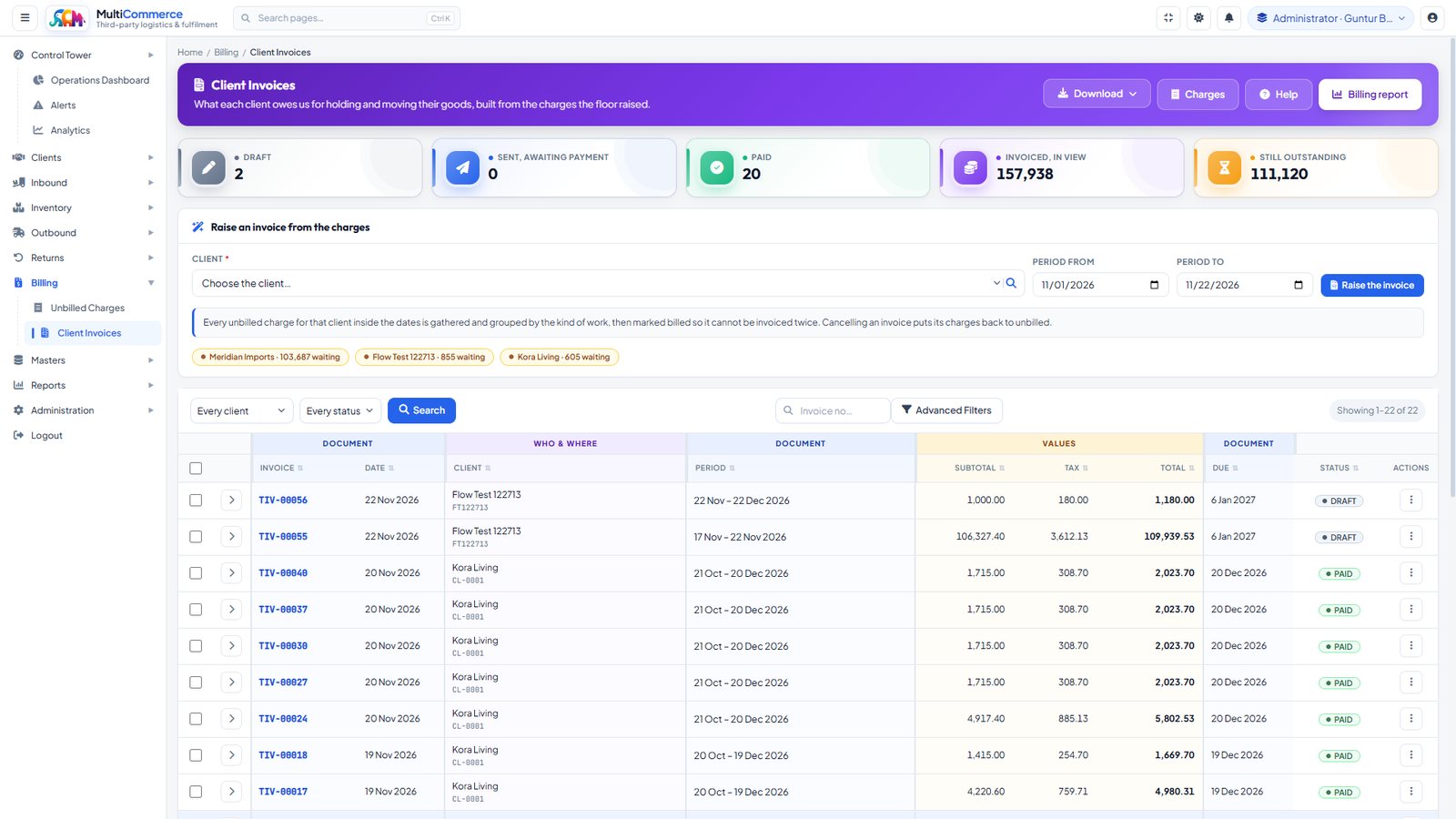
  • Client Invoices
  • Billing Analysis

Masters (9)

The reference data cartonisation, rate shopping and allocation all quietly depend on.

  • Clients
  • Consignees
  • Value-Added Services
  • Item Rules
  • Client Rules
  • Carrier Zones & Rates
  • Carriers
  • Units of Measure
  • Currencies

Integrations (5)

Where your orders come from and where your parcels go. Usually the real project.

  • Storefront Integrations
  • Channel Sync & Logs
  • Carrier API
  • EDI
  • Webhooks

Reports (6)

Evidence for the service-level conversation, internal or with a customer.

  • Inbound Report
  • Outbound Report
  • Inventory Report
  • Billing Report
  • SLA Report
  • Billing Analysis

Client Portal (9)

Not needed for your own stock, but the same screens serve a wholesale buyer well.

  • Portal Home
  • Their Stock
  • Their Orders
  • Order Entry
  • Their Shipments
  • Their Inbound
  • Their Returns
  • Their Invoices
  • Their Scorecard

Administration (5)

Who can do what, where things physically are, and what happened.

  • Users & Roles
  • Client Portal Logins
  • Company, Branches & Warehouses
  • Bins & Locators
  • Activity Log
Inside the system

The screens an order passes through

Six screens, following one order from acceptance to carrier handover. Tap any image to enlarge it.
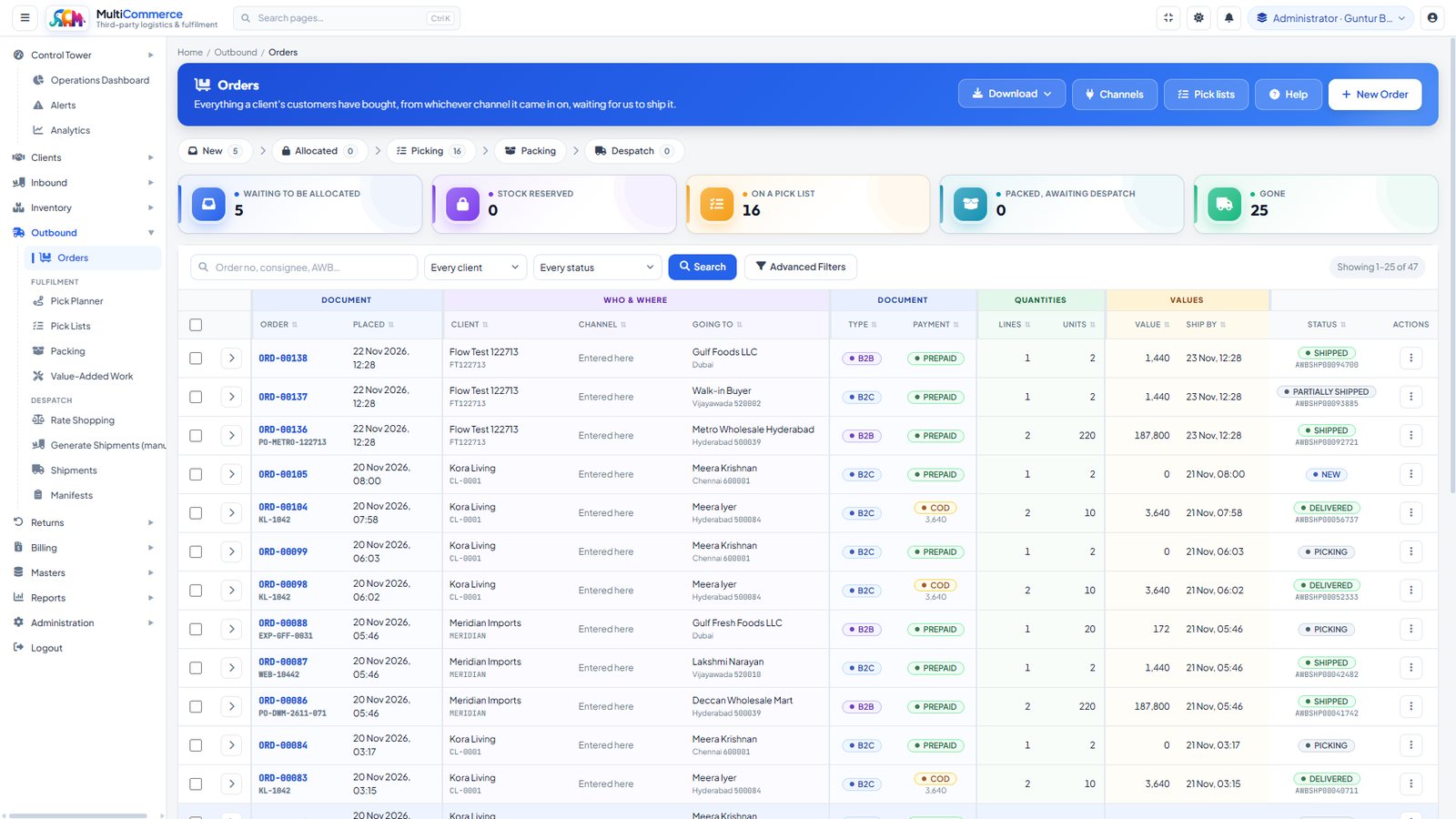
Orders — Every channel in one queue, with the ship-by hour on each line
OrdersEvery channel in one queue, with the ship-by hour on each line. The working view for whoever owns the day’s despatch.
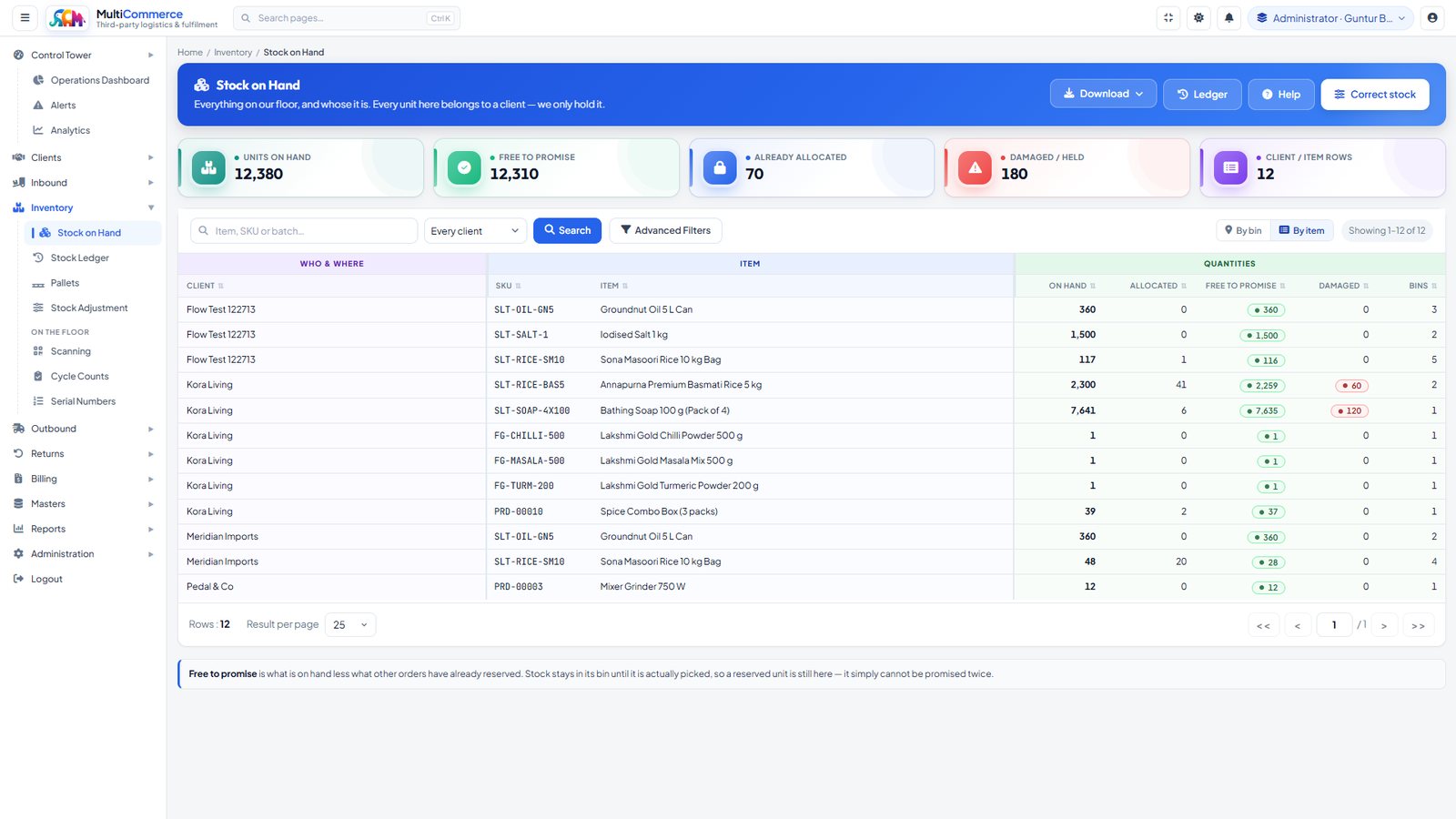
Stock on Hand — Balance by batch, expiry and bin — the figure allocation uses
Stock on HandBalance by batch, expiry and bin — the figure allocation uses, and the one that stops you selling what you cannot ship.
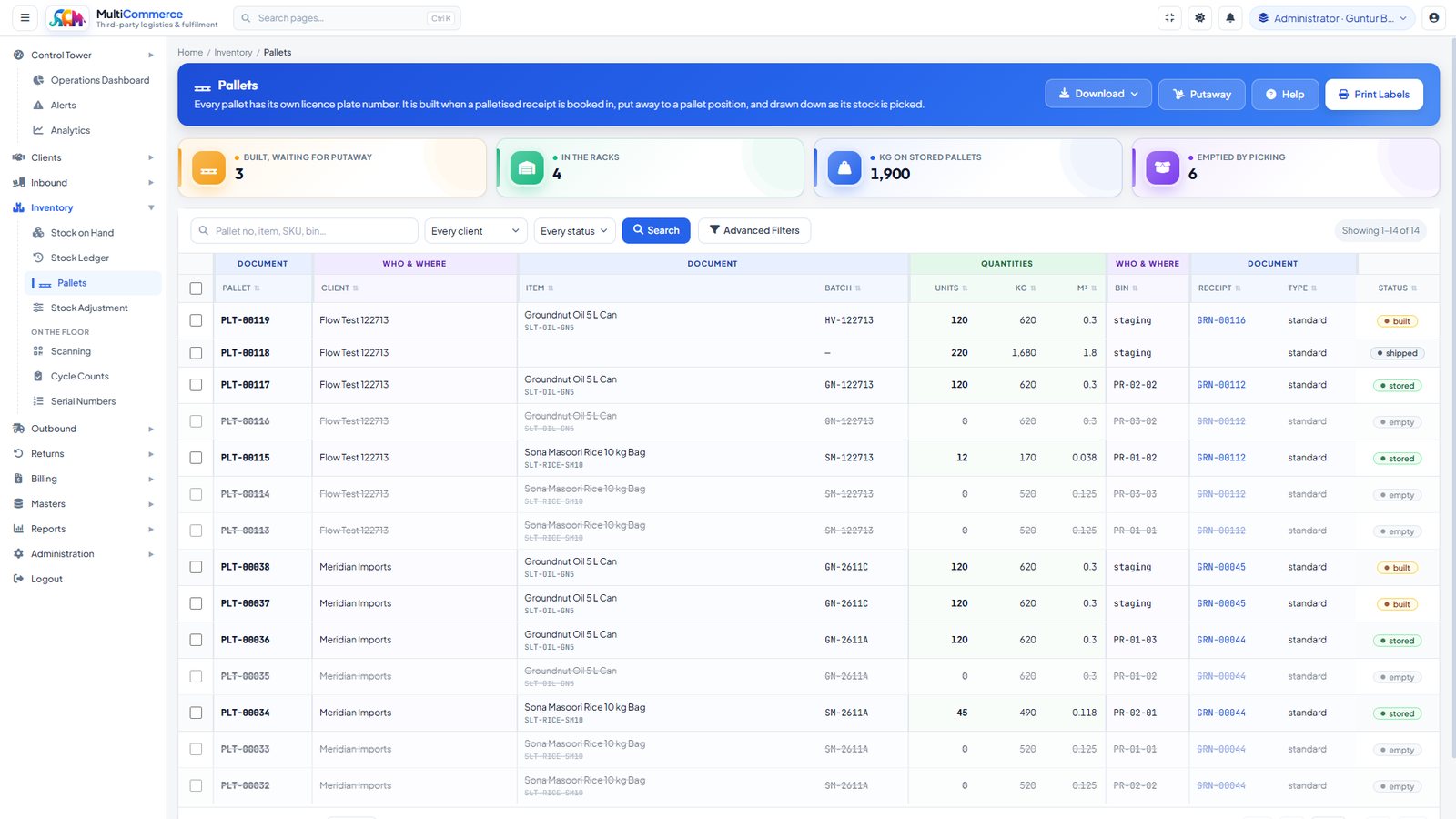
Locations and Pallets — The physical map behind the pick path
Locations and PalletsThe physical map behind the pick path. Sequencing a pick list by location is usually the largest free productivity gain on a mixed-SKU floor.
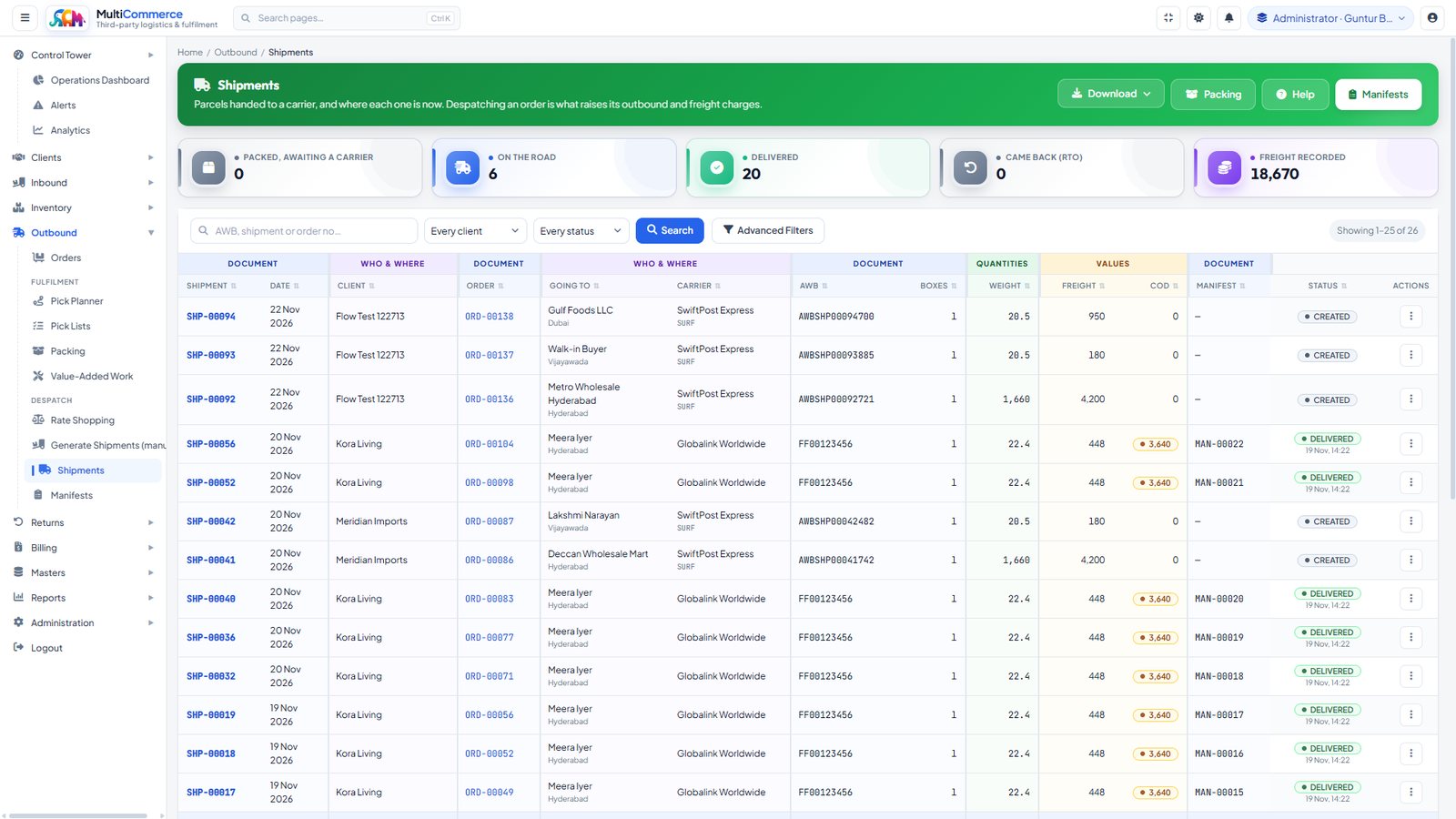
Shipments — Carrier, service, label and manifest per consignment
ShipmentsCarrier, service, label and manifest per consignment, with the cut-off visible before it is missed rather than after.
Order Tracking — Carrier status against the order. Parcels that stop moving surface here before the customer emails about
Order TrackingCarrier status against the order. Parcels that stop moving surface here before the customer emails about them.
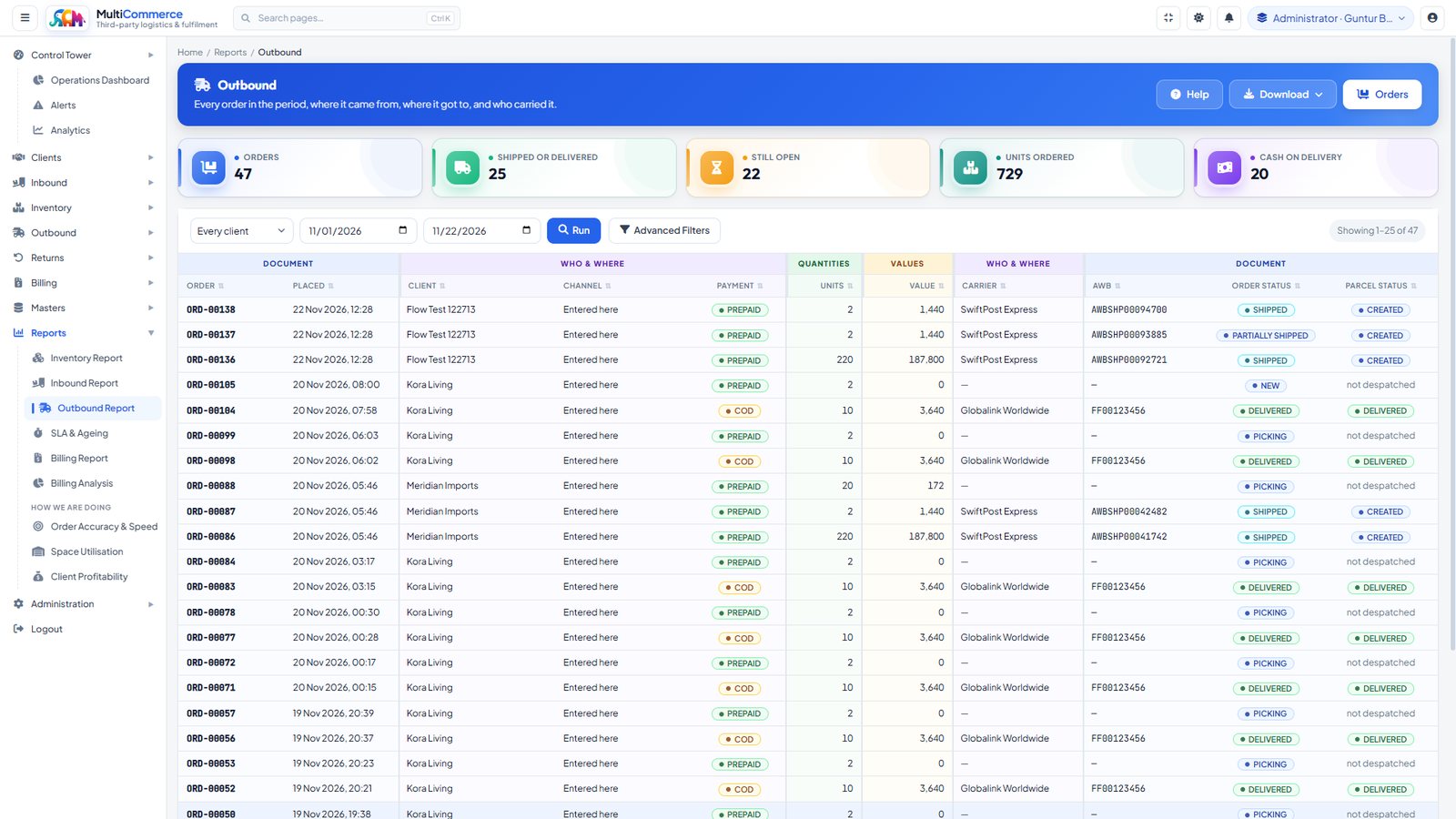
Outbound Report — Volume, lines, units and timing by day
Outbound ReportVolume, lines, units and timing by day. The evidence behind a service-level conversation, internal or with a customer.
Questions

Frequently asked questions about order fulfillment software

An order management system decides what should happen: which stock, which location, which carrier, in what order. Fulfillment software makes it happen on a floor - the pick path, the pack station, the label, the handover. Small operations buy one product that does both. Once you pass roughly a thousand orders a day the two halves usually separate.
Stop treating each channel's stock figure as authoritative. Hold one available-to-promise number centrally, subtract allocations the moment an order is accepted rather than when it is picked, and push the remainder outward on a short cycle. Overselling is almost always a timing problem rather than a counting one.
Single-order picking is simpler and slower; batching is faster and creates sortation work at the pack bench. The honest answer depends on lines per order. Mostly single-line orders batch very well. Multi-line orders with deep variety usually do not, and cluster picking into a trolley of totes beats both.
When your volume is either too small to justify a lease and a team, or too seasonal to staff sensibly, or growing faster than you can add space. The decision is rarely about cost per order alone - it is about what you want your own people spending attention on.
More than most brands budget, because the expensive part is not the inbound freight. It is the inspection decision: resaleable, refurbish, liquidate or scrap. Without a rule set someone makes that call item by item, slowly, and your resaleable rate drops.
Rarely the warehouse. Usually the order pipeline in front of it - a marketplace pushing orders faster than they can be acknowledged, a payment-capture step timing out, or a carrier manifest window closing while orders queue. Load-test the integrations, not just the pick rate.
Yes, and it usually should. The ERP stays the system of record for stock valuation, purchasing and accounting; fulfilment owns the operational detail of the day. What matters is agreeing which system is authoritative for availability, and never letting both think they are.
Keep reading

Where to read next

3PL order fulfillment software

The same work performed for other companies: client separation, service levels and billing the fulfilment itself.

ERP with warehouse management

Where stock control, purchasing and valuation sit behind the fulfilment floor.

eCommerce and ERP integration

Connecting storefronts and marketplaces so orders, stock and prices stay in step.

Multi-carrier integration

Rates, labels, manifests and tracking across DHL, FedEx, UPS and the rest.

Send Us One Day of Orders

We will model a day of your real order mix end to end and show you where the hours go. No cost, no obligation.