Mon – Sat: 9:00 AM – 7:00 PM IST

3PL Order Fulfillment Software — many clients, one floor

Fulfilling somebody else’s orders is a different problem from fulfilling your own.

When the stock is not yours, every decision acquires a second question: which client pays for it. Separation, service levels and billing stop being features and become the product. This page is about the operational software a third-party operator needs once fulfilment is the service being sold.

Free Proof of Concept Client data separated procedurally, not by promise Delivering since 2015
The difference

Fulfilling somebody else’s orders changes the software

A brand running its own fulfilment optimises for one thing: getting its own orders out. A third-party operator is running several of those operations at once, on one floor, with one team, under several different contracts that disagree about what good looks like. The physical work is similar. The software is not, because almost every decision now needs an owner attached to it before it can be made.

  • A pick belongs to a client, a contract, an SLA and an invoice line, all at once
  • Two clients can buy the same service at different prices and different service levels
  • Priority at the pack bench is a commercial decision, not a warehouse one
  • Your client is also your user, and sees only their own operation
  • Capacity is finite and shared, so allocation between clients has to be explicit

If you take one thing from this page: capture the event with the owner attached. Everything commercial downstream depends on having done that.

Separation

Four kinds of separation, and why reports are the one people forget

Stock

Owner-level balances down to batch and location. Shared bins only where the contract permits commingling, and adjustments that always resolve to one client's account.

Users

Your staff, your client's staff, and sometimes your client's own customers. Three audiences, three levels of access, one system.

Documents

Packing notes, labels, customs paperwork and photographs filed against the client they belong to, retrievable by them without asking you.

Reports

The one most often left porous. A report that can be re-filtered to show another client's volumes is a data incident waiting for an audit to find it.

Service levels

Per-client SLAs, measured rather than asserted

A service level nobody measures is a sentence in a contract. These are measured from events the system already holds.

Dispatch within window

Orders received before the agreed cut-off, dispatched the same working day. Define the cut-off precisely, including what happens to an order that lands two minutes after it, and show both sides the same number.

Pick accuracy

Measured from scan verification rather than from complaints. A client who can see 99.6% will argue less than one who has to infer it from the two errors they noticed.

Inventory accuracy

Cycle-count variance per client, per period. This is the number that decides whether they trust your stock figure enough to sell against it.

Returns turnaround

Hours from receipt to disposition. It is the metric brands feel most directly, because their customer is waiting on the refund at the other end of it.

Billing the work

The fulfilment events that become invoice lines

Storage bills itself from a snapshot. Fulfilment bills from things that happened, which means capturing them as they happen.

Receipt and put-away

Per pallet, per carton, per line or per unit depending on the contract. Capture the configuration of the inbound too: a container that arrives floor-loaded costs you far more than one on pallets, and most rate cards say so if anybody records it.

Pick and pack

The core line. Usually a first-line rate and a lower per-additional-line rate, sometimes banded by order size, sometimes different for B2B pallets and single-item direct-to-consumer parcels. All of these are the same physical team on the same floor.

Packaging and consumables

Cartons, void fill, tape, pallets and wrap. Small amounts individually and a meaningful recovery in aggregate — and the first thing to disappear from invoicing when capture is manual.

Value-added work

Kitting, bundling, re-labelling, gift wrap, serial capture, photographs, quality inspection. This is the highest-margin work most operators perform and the most commonly unbilled, because it happens at a bench rather than through a scan.

Returns processing

Receipt, inspection, disposition and restock, usually priced separately from outbound. Worth its own rate because it consumes labour unpredictably and the volume is not the client's forecast.

Labour

Planning one floor across several clients

Wave planning that respects contractsWaves built from carrier cut-offs and client SLAs together, so the floor works in the order the contracts require rather than the order the orders arrived.
Cost to serve, per clientHours attributable to each client against revenue from each client. Without it, a profitable operation can contain an unprofitable contract for years.
Flexing without favouritismWhen volume spikes for one client, somebody else's orders move. Making that rule explicit turns an awkward phone call into a clause.
Forecast against actualClients forecast optimistically. Holding their forecast next to what arrived is what makes the peak conversation a commercial discussion rather than an argument.
The client’s view

What a brand asks before handing over its orders

Worth reading as a checklist of what your sales team will be asked, and what your system has to be able to show.

Can we see stock without emailing you?

Live balances, by SKU and batch, with inbound visibility. The answer to this decides more deals than price does.

Will our storefronts connect?

Shopify, WooCommerce, BigCommerce, marketplaces and whatever else they run. Orders in, stock and tracking back out.

Do you ship on our carrier accounts?

Many brands have negotiated rates they intend to keep. Honouring them, and billing only the handling, is often the deciding factor.

What is the SLA, and how is it measured?

Expect to be asked for the definition and the evidence, not the number.

How is our data kept from competitors?

Particularly from brands in their category. Procedural separation, described plainly, beats a reassurance.

What happens at peak?

Allocation, surcharges, precedence. A clear answer here reads as competence; a vague one reads as a risk.

The modules

All 71 modules, read as a multi-client operation

The same complete feature set, framed for an operator fulfilling on behalf of other companies. The note on each group is what changes once the stock on the rack is not yours.

Control Tower (6)

Across every client at once, so priority is ranked on one floor rather than per account.

  • Control Tower
  • Alerts
  • Order Accuracy
  • Fulfillment Speed
  • Space Utilisation
  • Client Profitability

Inbound (6)

Each client’s inbound against their own notice, with the discrepancy owned by whoever caused it.

  • Advance Shipping Notices
  • Goods Receipts
  • Putaway
  • Dock Schedule
  • Gate Passes
  • Customs

Inventory (8)

Owner-level balances. This is the separation everything commercial rests on.

  • Stock on Hand
  • Stock Ledger
  • Stock Adjustment
  • Cycle Counts
  • Pallets
  • Serial Numbers
  • Scanning
  • Barcodes

Outbound & Order Fulfillment (9)

The work you are selling, performed under several contracts at once.

  • Orders
  • Allocation
  • Pick Planner
  • Pick Lists
  • Packing
  • Shipments
  • Manifests
  • Rate Shopping
  • Value-Added Work

Returns & Kitting (2)

Returns turnaround is the SLA brands feel most, because their customer is waiting.

  • Returns
  • Kits

Billing (6)

Where fulfilment becomes revenue. Events priced per contract at the moment they happen.

  • Rate Cards & Contracts
  • Conditional Rates
  • Charges
  • Storage Runs
  • Client Invoices
  • Billing Analysis

Masters (9)

One client’s handling rules must not become another’s. This is where that is held.

  • Clients
  • Consignees
  • Value-Added Services
  • Item Rules
  • Client Rules
  • Carrier Zones & Rates
  • Carriers
  • Units of Measure
  • Currencies

Integrations (5)

Every client arrives with their own storefronts and carrier accounts. Onboarding lives here.

  • Storefront Integrations
  • Channel Sync & Logs
  • Carrier API
  • EDI
  • Webhooks

Reports (6)

The same figures you and your client see, which is what makes the SLA conversation short.

  • Inbound Report
  • Outbound Report
  • Inventory Report
  • Billing Report
  • SLA Report
  • Billing Analysis

Client Portal (9)

The reason the phone stops ringing, and frequently the reason you win the contract.

  • Portal Home
  • Their Stock
  • Their Orders
  • Order Entry
  • Their Shipments
  • Their Inbound
  • Their Returns
  • Their Invoices
  • Their Scorecard

Administration (5)

Separation enforced by role and session, not by a filter somebody might change.

  • Users & Roles
  • Client Portal Logins
  • Company, Branches & Warehouses
  • Bins & Locators
  • Activity Log
Inside the system

What you see, and what your client sees

Three operator screens and three from the client portal, so you can compare the two sides of the same operation. Tap any image to enlarge it.
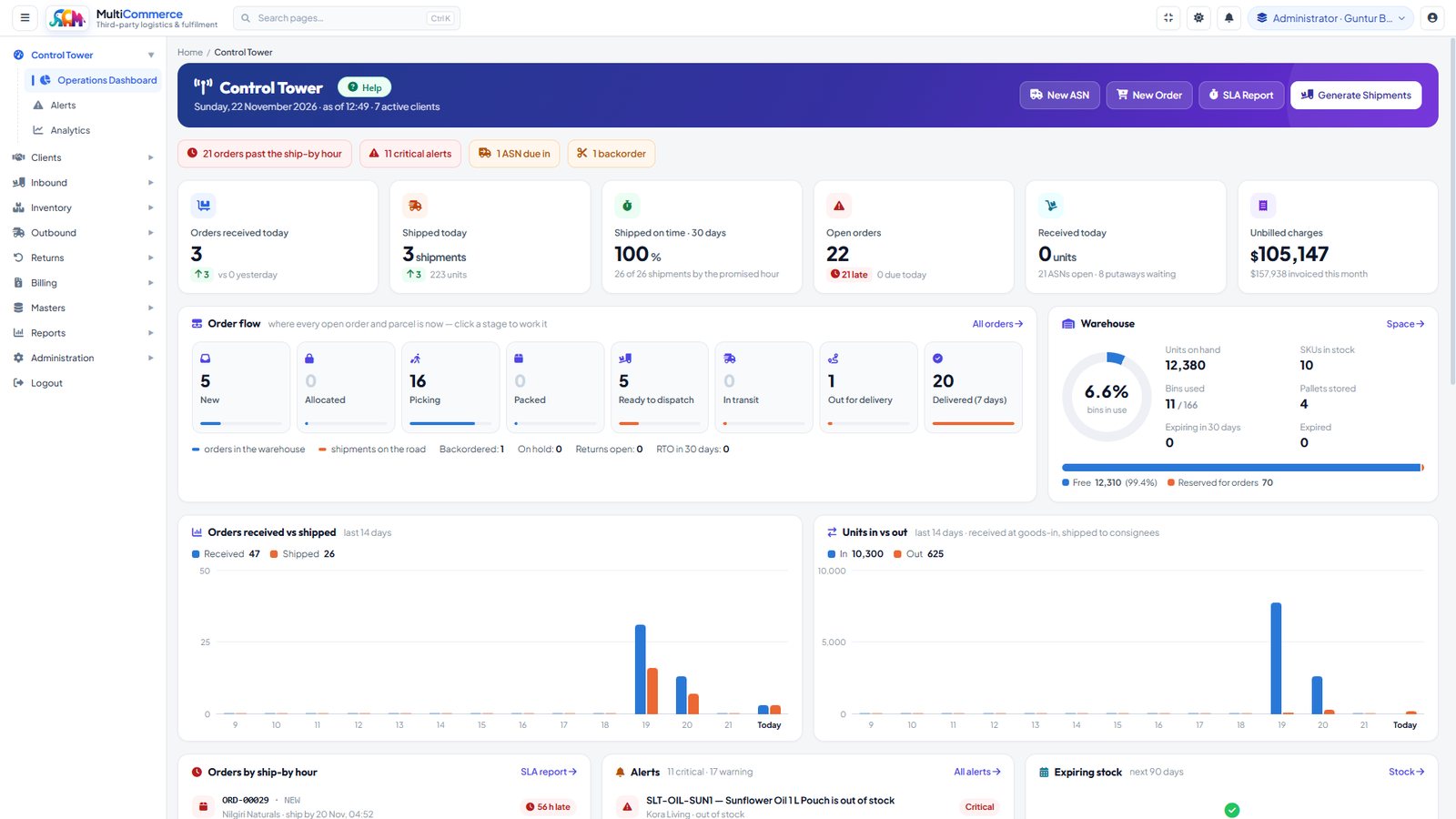
Control Tower — your view — Every client’s work on one screen
Control Tower — your viewEvery client’s work on one screen, with late orders and alerts ranked across the whole floor rather than per account.
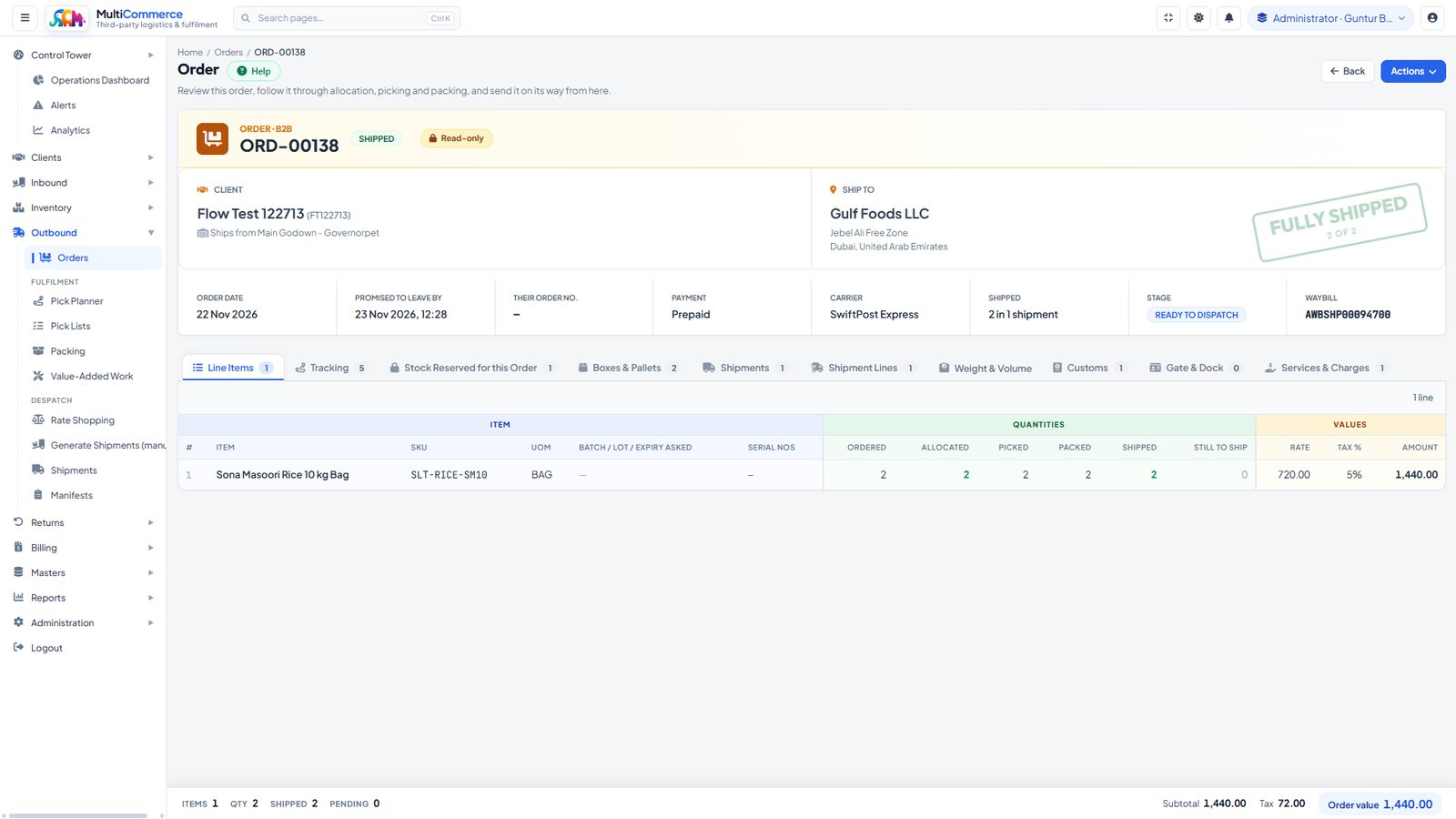
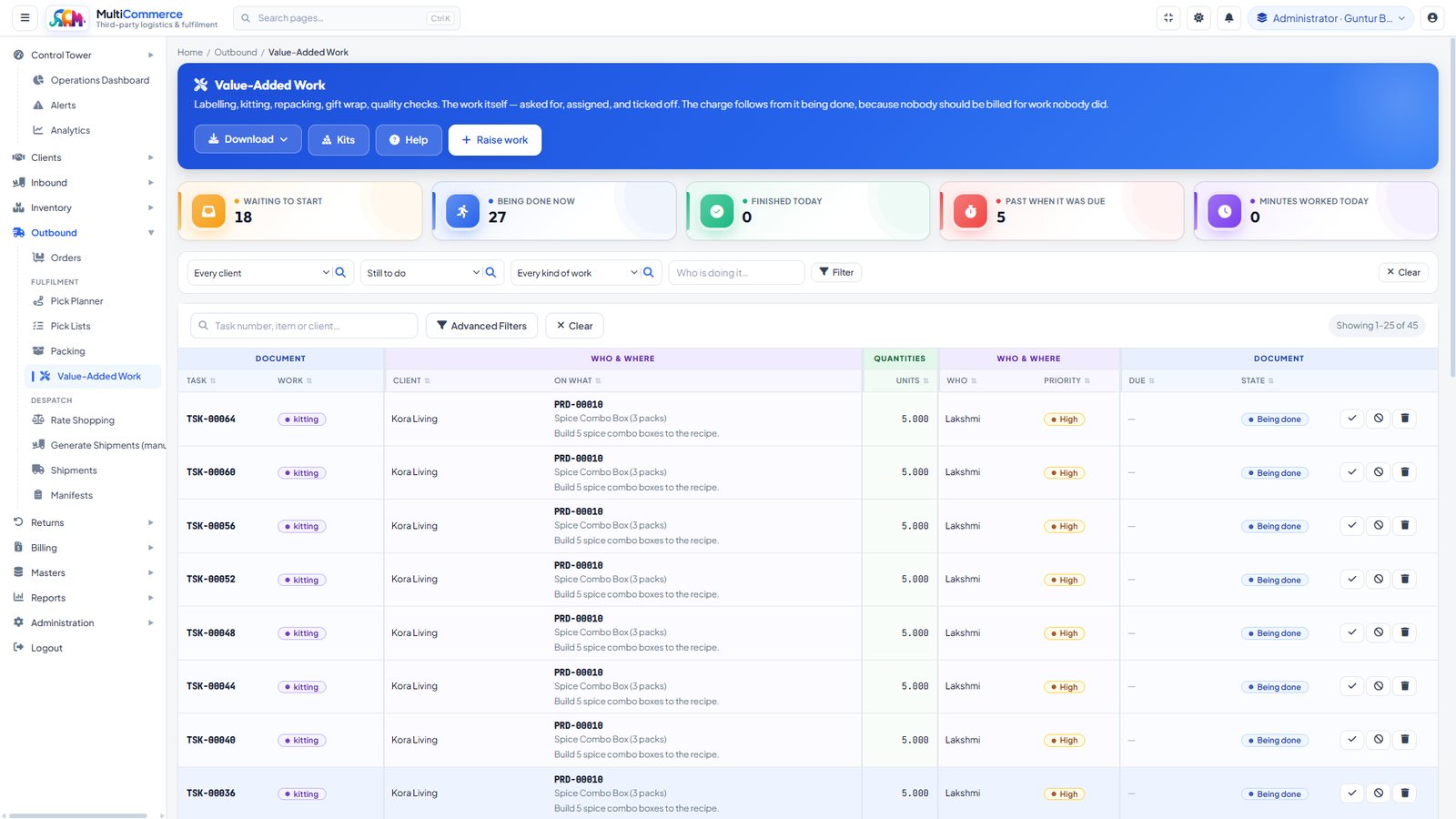
Value-Added Work — Kitting, re-labelling and inspection recorded as it is performed
Value-Added WorkKitting, re-labelling and inspection recorded as it is performed. This screen is the difference between billing the work and absorbing it.
Client Invoices — Built from captured fulfilment events with the detail behind each line
Client InvoicesBuilt from captured fulfilment events with the detail behind each line, so a disputed charge is answered with evidence.
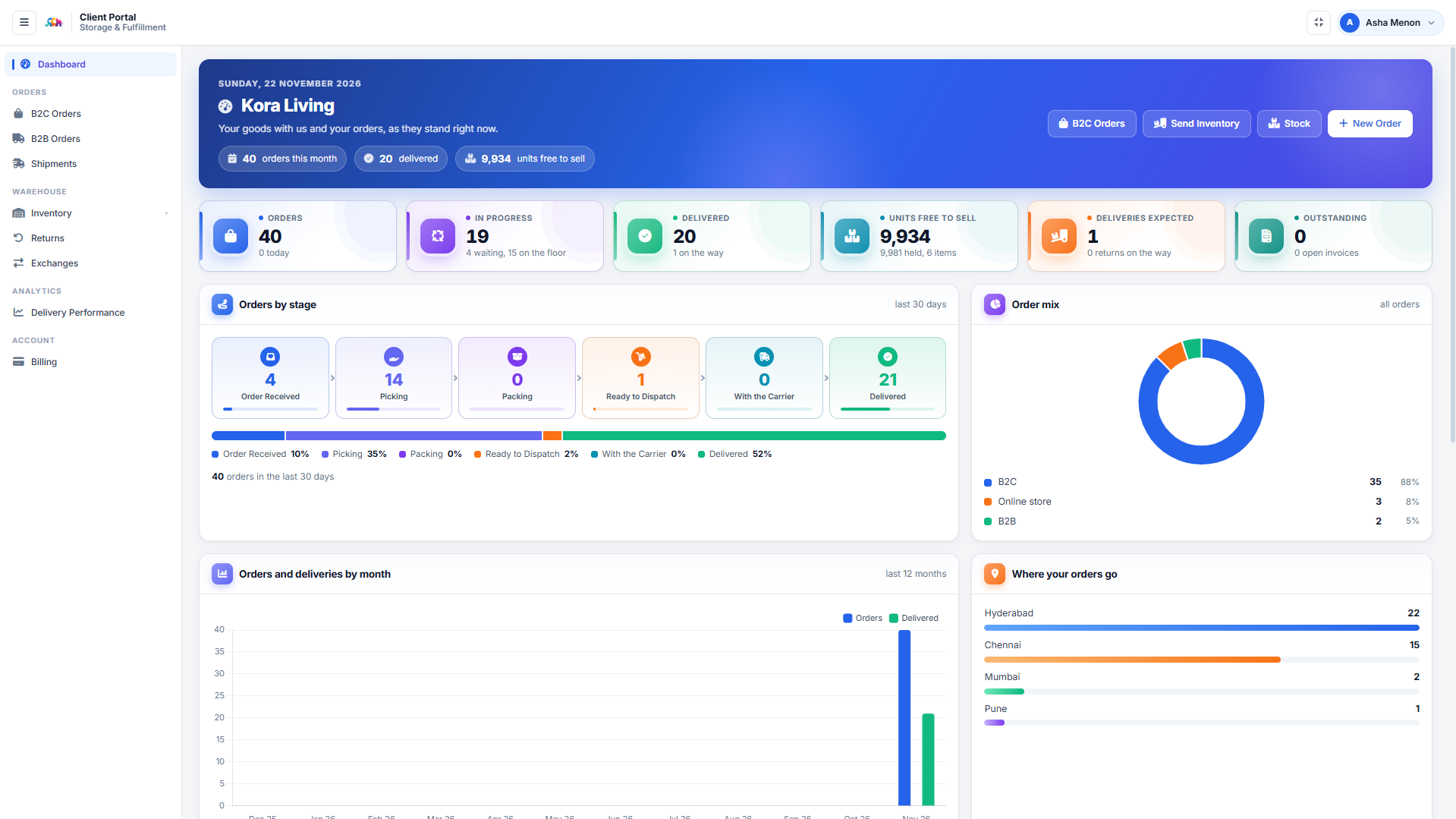
Client Dashboard — their view — What the brand sees when they sign in: their own stock, orders and exceptions
Client Dashboard — their viewWhat the brand sees when they sign in: their own stock, orders and exceptions, and nothing belonging to anybody else.
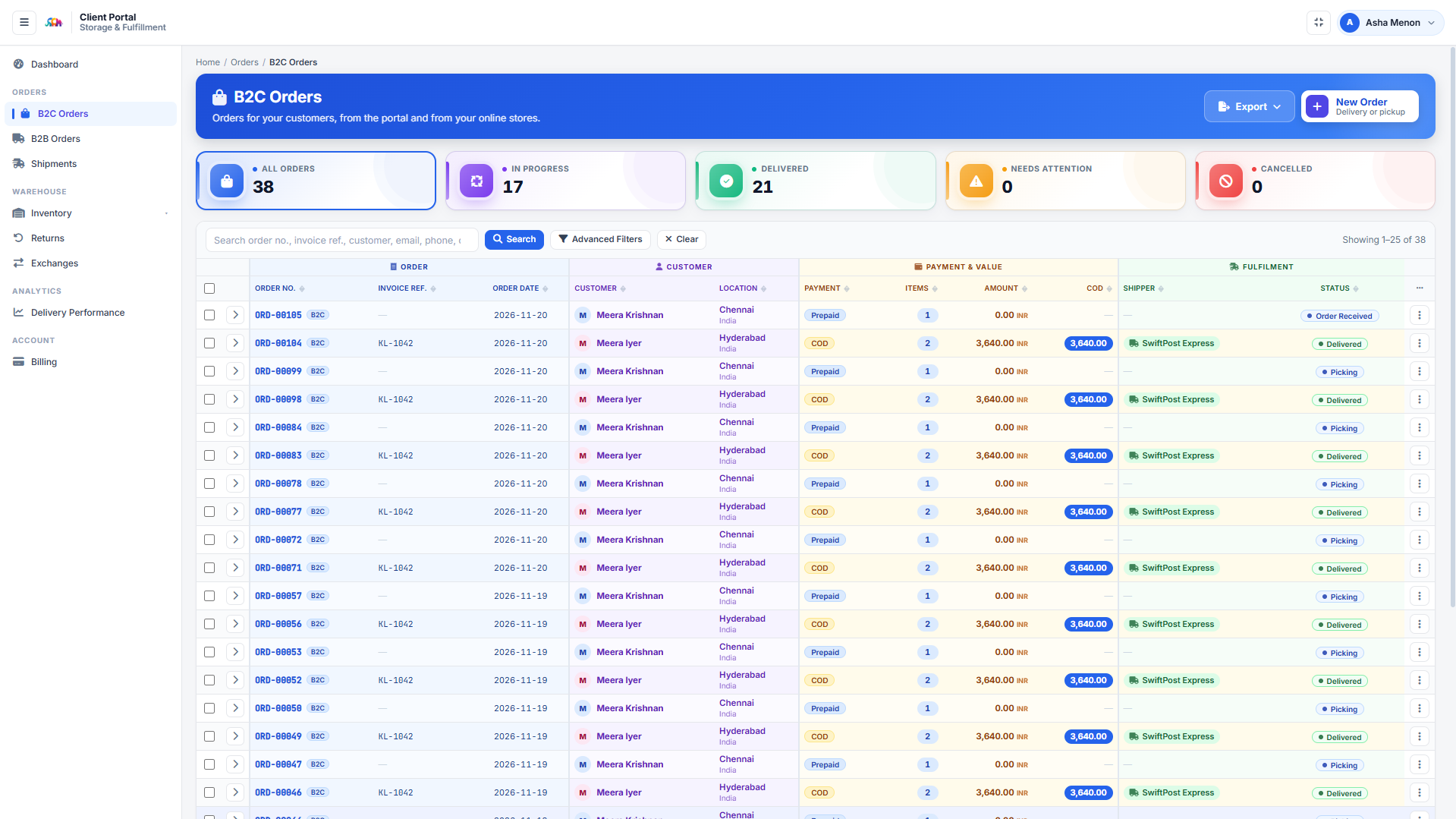
Their Orders — Order status by line with tracking attached
Their OrdersOrder status by line with tracking attached, so the brand answers its own customers instead of emailing your operations desk.
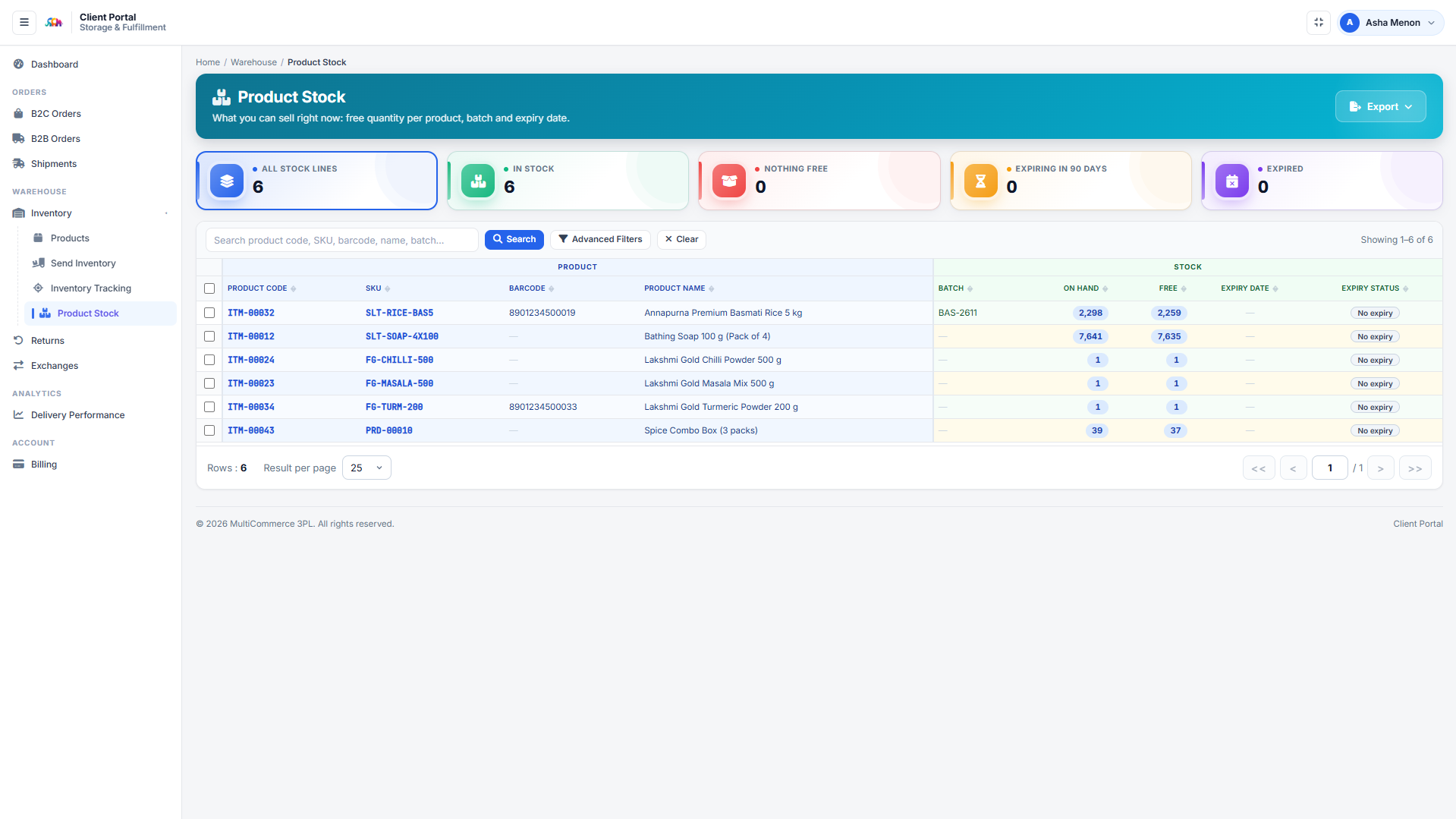
Stock by Batch — Batch and expiry visibility for clients whose products have shelf life
Stock by BatchBatch and expiry visibility for clients whose products have shelf life — the question that otherwise arrives by phone every week.
Questions

Frequently asked questions about 3PL order fulfillment software

Everything acquires a second question: which client. The pick is the same physical act, but it belongs to a contract, counts toward one client's SLA, consumes one client's stock and generates one client's invoice line. Software built for a brand has no concept of that second axis, and bolting it on afterwards rarely survives contact with a real rate card.
Separation has to be structural rather than a filter on a report. Stock, orders, documents, users and reporting all resolve to an owner, and a user without rights to a client simply cannot address that client's records. The test is simple: ask whether a mis-set filter could show one client another client's volumes. If it could, it is not separation.
Four things, measured automatically rather than asserted monthly: the proportion of orders dispatched within the agreed window, pick accuracy, inventory accuracy at cycle count, and returns turnaround. Each needs a definition both sides agree in writing - particularly what the cut-off means on a day the client sends orders at 17:59.
By capturing events as they happen and pricing them per contract. An order received, a line picked, a carton packed, a label produced, a kit assembled, a return inspected - each is a billable moment for some clients and included for others. Capture first, price second.
Visibility above all - live stock and order status without emailing you. Then integration to their storefronts, their carrier accounts honoured, a named contact, and clarity on what happens at peak. The ones who have been let down before will also ask how you separate their data from a competitor's.
Decide it commercially before December, not operationally during it. Agreed peak allocations, written into the contract, with a surcharge for exceeding a forecast and a stated order of precedence. Operators who leave this to the floor supervisor lose a client every January.
Often yes. Many operators keep their existing WMS for stock and movement and add the client, contract, billing and portal layer around it. The feasibility question is whether the WMS emits events with the owner attached - if it does, this works well; if it does not, it is a bigger job.
Keep reading

Where to read next

MultiCommerce 3PL, the system itself

The platform behind this: rate cards, picking strategies, billing capture and the client portal.

Choosing 3PL software

The category and the buying decision — build, buy or configure, how it is priced, what to ask a vendor.

Order fulfillment software

The same operation seen from the brand’s side, for companies shipping their own orders.

Integrations

Storefronts, marketplaces, carriers, banks and EDI — the connections each new client arrives with.

Load One Client. See the Invoice.

Give us one client’s contract and a month of their orders. We will show you the fulfilment events, the SLA and the invoice that comes out.