Enterprise ERP with zero licence fees — implemented, customised and supported end to end.
iDempiere gives you a full ERP under the GPLv2 licence: no per-user fees, no renewal invoices, no vendor lock-in. What it needs is a partner who knows the platform deeply. We have implemented, extended and supported iDempiere since 2015 — finance, sales, purchasing, inventory, manufacturing and projects — for businesses across India, the USA and the Middle East.
This page explains the product and the commercial case for it: a mature open-source ERP with no per-seat licence fee and full source access. Useful if you are still deciding whether open-source ERP is credible for your operation at all.
Once the platform decision is made, two questions follow. Choosing an iDempiere implementation partner covers who should deliver it, and the iDempiere cost and 5-year TCO breakdown covers what it actually costs to own.
The licence saving is real, but it is not the reason iDempiere wins — the reason is that you can change the system to match your business instead of the reverse.
Proprietary ERP forces you into someone else's process model and then charges per user to stay there. iDempiere ships the same enterprise capability — multi-organisation, multi-currency, multi-language accounting, a full document workflow engine and a genuine audit trail — with the source code in your hands. Our consultants run a fit-gap workshop against your actual processes, configure what can be configured, and build OSGi plugins for what genuinely cannot. Nothing is hacked into the core, so upgrades stay routine rather than becoming projects.
We work the same way after go-live. Because there are no licence renewals, the money you spend goes into implementation, integration and support — the parts that actually determine whether an ERP succeeds. Our AMS desk handles version upgrades, performance tuning, month-end support and new requirements as they arrive, and your source code is yours to take elsewhere if you ever want to. That asymmetry keeps us honest.
The full lifecycle — from a first fit-gap workshop to a stable go-live and long-term managed support.
Fit-gap workshops, configuration, data migration, user training and a rehearsed cutover — a typical mid-market go-live lands in 4-8 weeks.
Callouts, processes, custom windows and full OSGi plugins built the platform's way, so your changes survive every upgrade.
Compiere, ADempiere and legacy ERP migrations, plus version upgrades with your customisations carried forward and reconciled.
SLA-backed support, monitoring, backups, month-end assistance and a continuous improvement backlog after go-live.
Everything a growing business needs from an ERP — with the source code included.
Multi-org, multi-currency general ledger with a full audit trail.
Invoicing, collections, ageing, payments and bank reconciliation.
Quotations to orders, shipments and invoices with pricing rules.
Requisitions, purchase orders, receipts and vendor invoice matching.
Multi-warehouse stock, lots, serials, costing and movements.
BOMs, work orders, routing and production costing.
Configurable approvals and document routing across every process.
Several legal entities and branches in one consolidated instance.
Global teams working in their own language on the same data.
Documented APIs for eCommerce, carriers, banks and custom apps.
Live KPI dashboards plus a report writer for the rest.
Warehouse and approval apps on Android and iOS.
We combine deep delivery expertise with an affordable delivery model so you capture measurable results — without overspending.
iDempiere is a single integrated application, not a bundle of separate products — every module below posts to the same ledger, shares the same business partner and product masters, and runs through the same workflow and security engine. These are the areas we configure, extend and support in production.
Multi-organisation, multi-currency accounting with user-defined account schemas. Every transaction in every module posts here automatically, so the ledger is never a separate reconciliation exercise.
Customer invoicing, credit limits, payment allocation, ageing analysis and dunning. Open items are matched against receipts with full traceability back to the originating order.
Vendor invoices matched three-way against purchase orders and goods receipts, with payment scheduling, holds and remittance generation.
Bank accounts, cash books, deposits, payment batches and statement reconciliation — including electronic bank file import and matching rules.
Asset register with acquisition, depreciation schedules, revaluation, transfer and disposal, posting automatically to the correct depreciation accounts.
Budgets by account, period, organisation, project or activity, with actual-versus-budget reporting and optional commitment control on purchase orders.
Configurable tax categories and rates covering GST, VAT and withholding, with tax computed at document level and reported for statutory filing.
A report writer producing trial balance, P&L, balance sheet and cash flow to your own line structures — with drill-down from any figure to the source document.
Quotations converting to sales orders, with standard, credit, warehouse, POS and prepay order types each driving their own document and stock flow.
Price lists by currency and version, with break quantities, customer-specific pricing and discount schemas applied automatically at order entry.
Picking, packing and delivery notes generated from orders, with partial shipment, back-order handling and confirmation workflows.
Invoices raised from orders or shipments, individually or in batch, with consolidated invoicing and configurable print formats per customer.
Customer returns received back into stock with inspection disposition, and credit notes raised and allocated against the original invoice.
Orders fulfilled directly by the vendor to your customer, plus inter-warehouse distribution orders with in-transit stock visibility.
Commission rules by salesperson, product or customer, calculated on invoiced or paid revenue and posted for settlement.
Counter sales with cash drawer, tender types and immediate stock and ledger posting — useful for showrooms and trade counters.
One record for customers, vendors, employees and prospects — with multiple addresses, contacts, bank details, payment terms and credit rules shared by every module.
Leads qualified into opportunities with sales stages, expected close dates and probability-weighted pipeline value against the same partner used for billing.
Marketing campaigns and sales channels tagged onto orders and invoices, so revenue can be attributed back to the activity that produced it.
Calls, meetings and tasks logged against a partner or opportunity, with reminders and a complete interaction history for whoever picks up the account next.
Customer requests and complaints raised as tracked tickets with categories, priorities, assignment and escalation — linked to the order or product concerned.
RfQs issued to multiple vendors or received from customers, with responses compared side by side before an order is raised.
A web portal where customers view their orders, invoices, payments and open requests — reducing the volume of routine enquiries reaching your team.
Internal purchase requests with approval routing and budget checks, consolidating into purchase orders once authorised.
Orders against vendor price lists with delivery schedules, blanket orders and drop-ship handling straight to the customer.
Receipt against purchase order with over- and under-delivery tolerance, quality hold and automatic stock and accrual posting.
Three-way match of purchase order, receipt and vendor invoice, with variance handling so nothing is paid without evidence.
Return-to-vendor documents with credit note handling, reversing stock and accounting entries correctly.
Freight, duty and clearing charges distributed across received lines so inventory carries its true cost, not just the invoice price.
Products, categories, units of measure with conversions, substitutes, bill-of-material links and per-organisation settings.
Any number of warehouses, each with aisle, bin and level locators, and stock visible by location rather than as a single pooled figure.
Attribute sets carrying lot, serial and expiry data through receipt, movement and shipment for full forward and backward traceability.
Internal movements between locators and warehouses, with in-transit handling for inter-organisation transfers.
Full counts and cycle counting by category or location, with variance approval before adjustments post to the ledger.
Standard, average, FIFO or LIFO costing per product category and organisation, with cost adjustment and revaluation processes.
Minimum and maximum levels by warehouse driving automatic requisition or order proposals when stock falls below reorder point.
Valuation reporting by warehouse, category and period, reconciled to the inventory accounts in the general ledger.
Multi-level BOMs with phantom assemblies, alternatives and effectivity dates, plus where-used enquiry across the product structure.
Operation sequences with work centres, setup and run times, feeding capacity planning and production scheduling.
Work orders issuing components, recording completions and scrap, and closing with full material and labour accountability.
Actual material, labour and overhead accumulated against each order, with variance analysis against standard cost.
Inspection points on receipt and production with pass, hold and reject dispositions, and non-conformance records for audit.
Material issued to a subcontractor and finished goods received back, with the processing charge costed into the product.
Projects with phases and tasks, budgets by line, and every order, invoice and issue linked back to the project.
Materials, time and expenses accumulated against the project, giving live committed and actual cost against budget.
Milestone, time-and-material or percentage-of-completion invoicing generated directly from project activity.
Timesheets and expense reports captured against projects or activities, feeding both billing and cost.
Service requests and maintenance work against registered assets, with parts consumption and labour recorded.
Employees held as business partners with grade, department, designation, reporting line, joining date and bank details — shared with purchasing, projects and expense claims rather than kept in a separate system.
Contract types, pay periods and effective-dated salary structures, with revisions and arrears handled without rewriting history.
Payroll definitions built from concepts, rules and formulas, so earnings, deductions and employer contributions are calculated to your own policy and posted straight to the ledger.
Attendance and leave captured from biometric devices or our HRMS and fed into payroll as inputs, so days worked, absence and overtime drive pay automatically.
Provident fund, ESI, professional tax, income tax and gratuity configured as payroll concepts, with the returns and registers needed for filing.
Payslip generation and distribution, plus salary registers, bank transfer files and payroll journals posted to the correct accounts.
Employee travel and expense claims captured against projects or cost centres, routed through approval and settled through accounts payable.
Every asset recorded with identification, purchase document, supplier, warranty period and expected life — created automatically from the purchase invoice that acquired it.
Asset groups carrying their own useful life, depreciation method and default accounts, so classification drives the accounting automatically.
Assets issued to employees, departments or sites with acknowledgement, giving a complete custody history and a clear record of who holds what.
Transfers between locations, organisations and custodians, with returns recorded and the asset's location always current.
Scheduled and breakdown maintenance raised against the asset, with spare parts consumed from stock and labour costed to the asset record.
Sale, scrapping or write-off with gain and loss calculated against net book value and posted, closing the asset's lifecycle cleanly.
The heart of iDempiere — add fields, windows, tabs, validation rules and processes through configuration rather than code.
Document approval routing by amount, role or organisation, with escalation, delegation and a complete approval history.
Role-based access down to window, tab, field and record level, with organisation-level data isolation for multi-entity groups.
Several legal entities in one instance with intercompany documents, currency conversion rules and consolidated reporting.
Interface and document translation, so each user works in their own language while the data stays common.
Change log recording who altered which field, when, and from what value — with document history retained for audit.
Import loaders for partners, products, orders and balances, with validation before posting, plus scheduled exports.
Background processes on a schedule, plus alerts that email or notify when a defined condition is met.
Configurable document layouts and Jasper reports, so invoices and statements match your brand without custom code.
Custom behaviour packaged as plugins that install alongside the core, so your changes survive every version upgrade.
Field-level logic and custom processes that enforce your rules at the point of entry rather than after the fact.
Documented REST and SOAP endpoints for storefronts, carriers, banks, mobile apps and reporting tools.
Indian GST configuration with IRN generation, e-way bill support and GSTR-ready extracts for filing.
Warehouse scanning and approval apps on Android and iOS, talking to the same instance over the REST API.
Role-based dashboards with live KPI gauges, plus extraction into external BI tools where deeper analysis is needed.
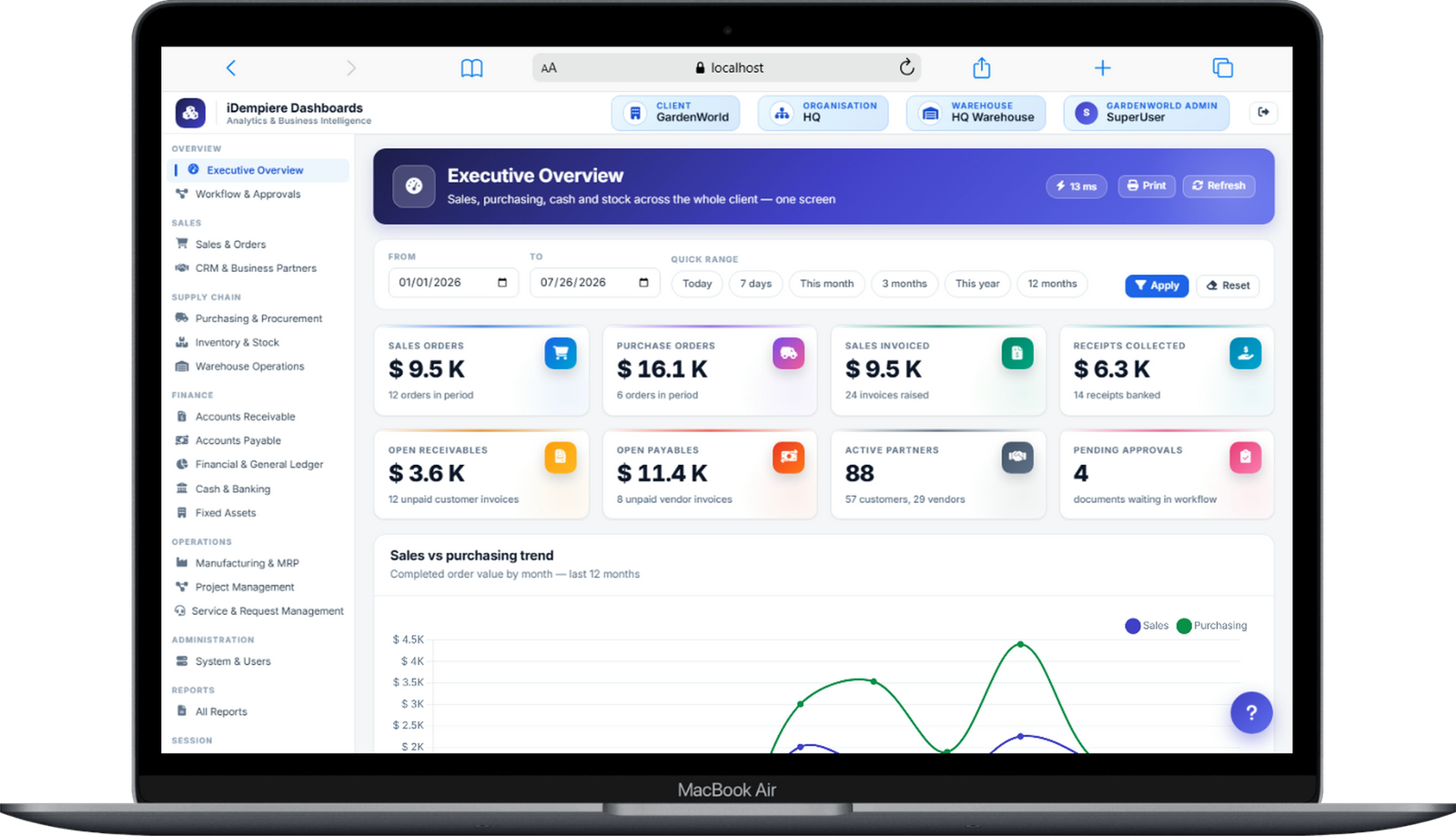
Standard ERP reporting answers questions once you know which report to open. We built a separate web application that sits on the same database and answers them the moment you log in — live, on any device, with every figure traceable back to the document behind it.
This is a product we developed ourselves, not a bolt-on report pack. It reads directly from your iDempiere instance, so there is no overnight batch, no extract and no separate warehouse to keep in step. Executives see sales, purchasing, cash and stock on one screen; each module then has its own board filtered by period, organisation and warehouse.
"We go beyond installing software to ensure your ERP delivers measurable business outcomes. With iDempiere implementations across India, the USA and the Middle East since 2015, our team blends accounting depth, OSGi engineering and migration experience. From a free proof of concept to 24x7 managed support, we focus on creating sustainable value at every stage. Partner with us to run enterprise ERP without the enterprise licence bill."
Every stage is visible to you, with a working system on your own data long before cutover — so go-live day is rehearsed, not discovered.
Fit-gap workshop against your real processes
Configuration blueprint and extension plan
Configure, develop plugins and integrate
Master data, open items and opening balances
Rehearsed cutover with hypercare support
AMS, upgrades and continuous improvement
We deliver open-source ERP across industries — each with its own costing, compliance and process demands.
BOMs, work orders, production costing and shop-floor control.
Multi-warehouse stock, pricing tiers and carrier integration.
Batch, expiry and traceability for regulated supply chains.
Omnichannel orders, returns and real-time inventory.
Project costing, materials and subcontractor management.
Perishables, cold chain and lot management from farm to buyer.
Procurement, assets and institutional finance.
Spare parts planning and dealer replenishment.
Medical supplies, equipment and multi-location traceability.
Project accounting, time, expenses and billing.
Consumables, procurement and multi-property stock.
Critical spares, maintenance parts and asset operations.
The commercial case for open-source ERP, stated plainly.
iDempiere is released under the GPLv2 licence. There is no per-user fee, no annual renewal and no audit clause — the software is free and stays free. What you invest in is making it fit your business, which is the part that actually determines whether an ERP delivers.
No per-user fees and no renewals — for ten users or a thousand. Budget moves from licences to the work that creates value.
The full source code and your database are yours. Any competent partner can take over — including your own team.
The application dictionary and OSGi plugin model let you change behaviour without forking the core.
Because customisations sit outside the core, moving to a new version is a planned task, not a re-implementation.
Orders flow in from every sales channel and shipments flow out to every carrier — automatically, in real time, with no re-keying.
iDempiere ships with a documented REST API and an open data model, so connecting a storefront, marketplace, carrier or bank we have not integrated before is straightforward — no core changes and no middleware licence. Authentication, rate limiting and retry handling are built in, and every exchange is logged for audit and troubleshooting.
Because open source without expertise is just source code. We bring the expertise.
Forms and filters are dead UX. We embed an AI conversation layer into the systems we ship — so your people get answers, charts and actions in seconds, without learning your menu tree.
User: Which customers are over their credit limit right now?
AI: Seven customers — here are the three largest exposures.
User: Put those three on credit hold and notify their sales owners
AI: Done — credit hold applied on all three and the account owners notified. Open the list →
Every system we build now ships with an optional AI assistant that reads your real data — orders, stock, receivables, production — and answers in natural language. No new tab, no separate chatbot tool. Just a conversation, where the work happens.
Behind the scenes we also build with Claude — pairing it on architecture, code generation, test writing and migrations. The same AI that writes our code now lives inside your system to serve your team.
Your user types — or speaks — a plain English question or instruction inside your app.
It understands the request, pulls exactly the right information, and stays within each person's access.
The answer lands as a chart, table, summary or one-click action — right inside your app, not in a side panel.
NDA-first · 30-minute strategy call · we ship a working prototype in two weeks
Your chart of accounts, customer list and pricing are the core of your business. We protect them with legally binding agreements and strict confidentiality protocols on every engagement.
Every engagement starts with a signed NDA — before any discovery call, demo or data exchange. Your financial data, customer lists and business logic stay confidential.
You own 100% of the source code and intellectual property. No vendor lock-in, ever.
We build trust through transparency, reliable delivery, and ongoing support that grows with you.
We deliver a working Proof of Concept before any financial commitment. See your own chart of accounts and products on real iDempiere screens, and decide with confidence — no upfront charges, no lock-in contracts.
We configure a working iDempiere instance with your real chart of accounts, products and customers in just 2-3 weeks — completely free of charge.
Get full source code and IP ownership of your project for an additional fee. No vendor lock-in — you control your software.
Not satisfied? Walk away with zero obligation. No penalty, no questions asked. The POC is yours to keep either way.
We don't believe in trapping clients. Flexible engagement models — fixed price, T&M, or dedicated team. You choose.
Ready to see iDempiere running on your own data — for free?
Schedule Free ConsultationNo credit card required • No commitment • Response within 24 hours
Six pages cover iDempiere here, each answering a different question — the practice, choosing a partner, what it costs, and the three integrations clients ask for most. Whichever you landed on, the rest are one click away.
Let us show you what open-source ERP looks like on your own numbers.
