One cloud HRMS that runs the entire hire-to-retire employee lifecycle.
HR teams need more than a payroll tool — they need a single connected system. From recruitment and onboarding through attendance, payroll and statutory compliance to performance, learning and exit, our HRMS consultants replace spreadsheets and disconnected apps with one platform that scales with your headcount.
This page is for organisations running people in more than one country, where the problem is not any single payroll but keeping one employee record when the rules differ per location. Attendance, leave, performance and exit run on a shared system while statutory handling stays country-specific.
Most HR teams do not have a software problem — they have a disconnected data problem, where attendance lives in one tool, payroll in another and employee records in a spreadsheet.
Our HRMS consultants replace that patchwork with one platform where every module shares data in real time. Attendance feeds payroll automatically, recruitment flows into onboarding, and performance ratings link to increments — eliminating re-entry and the reconciliation work that consumes HR every month. Whether you are running a greenfield rollout, replacing a legacy system, in-sourcing outsourced payroll or consolidating multiple HRMS platforms after an acquisition, we build a 90-day plan, validate it with a parallel payroll run, and own go-live with the same team that supports you afterwards.
Solutions are built from a configurable platform, not a custom one-off. That means lower total cost of ownership, faster go-live, painless upgrades and a roadmap that gets richer every quarter — you ride the product roadmap instead of paying for it once and freezing. Beyond go-live we run managed HR services: statutory patches, monthly health checks, a payroll bureau, employee self-service adoption programmes and a named customer success manager — so your HR team stops firefighting and starts measuring outcomes.
We modernise HR operations — from core employee records to payroll and statutory filing — with cost-effective, compliance-ready solutions that your team can actually run.
Deploy core modules — employee master, attendance, leave, payroll and self-service — in weeks, not quarters, with minimal disruption to monthly payroll cycles.
Configure earnings, deductions, PF, ESI, professional tax, TDS and gratuity, then prove it with a parallel run against your existing payroll before cutover.
Move historical employee, leave-balance and payroll data cleanly, and connect biometric devices, banks, accounting and ERP systems through secure APIs.
Statutory patches, monthly health checks, payroll bureau support, ESS adoption programmes and a named success manager after go-live.
A complete platform covering every HR process — each module sharing data with the others in real time, so nothing is entered twice.
One record per employee — personal, job, family, documents and history.
Flexible salary structures, arrears, off-cycle runs and payslip generation.
Biometric, mobile and web punches with shift rosters and overtime rules.
Configurable leave types, accruals, carry-forward and approval chains.
Requisitions, job postings, screening, interviews, offers and joining.
Pre-joining tasks, induction, document collection and probation tracking.
Goal setting, review cycles, ratings, calibration and increment linkage.
PF, ESI, PT, TDS, gratuity and bonus with ready-to-file returns.
Training programmes, skill matrix, certifications and completion tracking.
Employee and manager self-service on mobile and web for everyday tasks.
Asset issue and return, plus employee ticketing with SLAs and escalation.
Headcount, attrition, cost-to-company and compliance dashboards.
We combine deep HR and payroll expertise with an affordable delivery model so you capture measurable results — without overspending.
286 menu items across more than a thousand screens, from the organisation masters through to final settlement — one system rather than a payroll tool with satellites bolted around it. Every module below shares the same employee record, approval matrix and data-scope rules.
Headcount, joiners, exits and pending actions — the board the HR team runs the day from.
Open requisitions, pipeline by stage, offers out and time-to-hire.
Cost by period, department and cost centre, with the current run's status.
Cycle progress, rating distribution and goals at risk.
Present, absent and on-leave today, plus balances and pending approvals.
Statutory position at a glance — contributions due, filings pending and records incomplete.
Legal entities and their locations, each with registrations and defaults that flow into payroll and statutory.
The structure cost is reported against, and the dimension every payroll journal carries.
Job titles and grade bands that drive eligibility, salary ranges and approval limits.
Permanent, contract, probation, intern and consultant — each with its own rules for leave, payroll and statutory.
Where people actually sit, which can differ from the branch they are payrolled under.
Shift timings and rotation, plus the weekly-off pattern that decides which days are paid.
Declared holidays maintained per location, because a national list rarely matches a given site.
Job definitions, the positions that exist against them, and the skills and competencies used in hiring and appraisal.
Who approves what at which level, and who can see whose records — configured once and obeyed by every module.
Accounts tied to the employee record, so a leaver loses access as part of exit rather than as a separate task.
Role definitions for HR, manager, finance, employee and administrator.
Fine-grained module and action rights granted to roles, not to individuals.
Geography driving address format, statutory jurisdiction and reporting.
Multi-currency payroll and per-location time handling for teams spread across countries.
Interface languages, plus the reference lists — religion, blood group — statutory forms in some jurisdictions require.
Hiring demand raised by a manager and approved before any advert exists, tied to a budgeted position.
Approved requisitions become openings, published to the channels you use.
One candidate record across every role they apply for, with the full application history.
Shortlisting against the requisition's criteria, with reasons recorded for those rejected.
Scheduled rounds with structured scoring from each panel member rather than a verbal verdict.
Offer generation with the salary structure attached, approval routing and acceptance tracking.
Verification status before joining, plus agency and source tracking so cost-per-hire is measurable.
Everything that must happen before day one, tracked from the moment the offer is accepted.
The candidate becomes an employee, carrying their record forward instead of being re-entered.
Orientation scheduled and attendance recorded against it.
Joining paperwork collected and checked off, with what is still missing visible.
Equipment handed over and logged to the person, and a buddy assigned for the first weeks.
Checklists and tasks through probation, with review and confirmation as a recorded decision.
The workforce directory with every filter you need, exportable and permission-scoped.
Identity, addresses and emergency contacts, editable by the employee where you allow it.
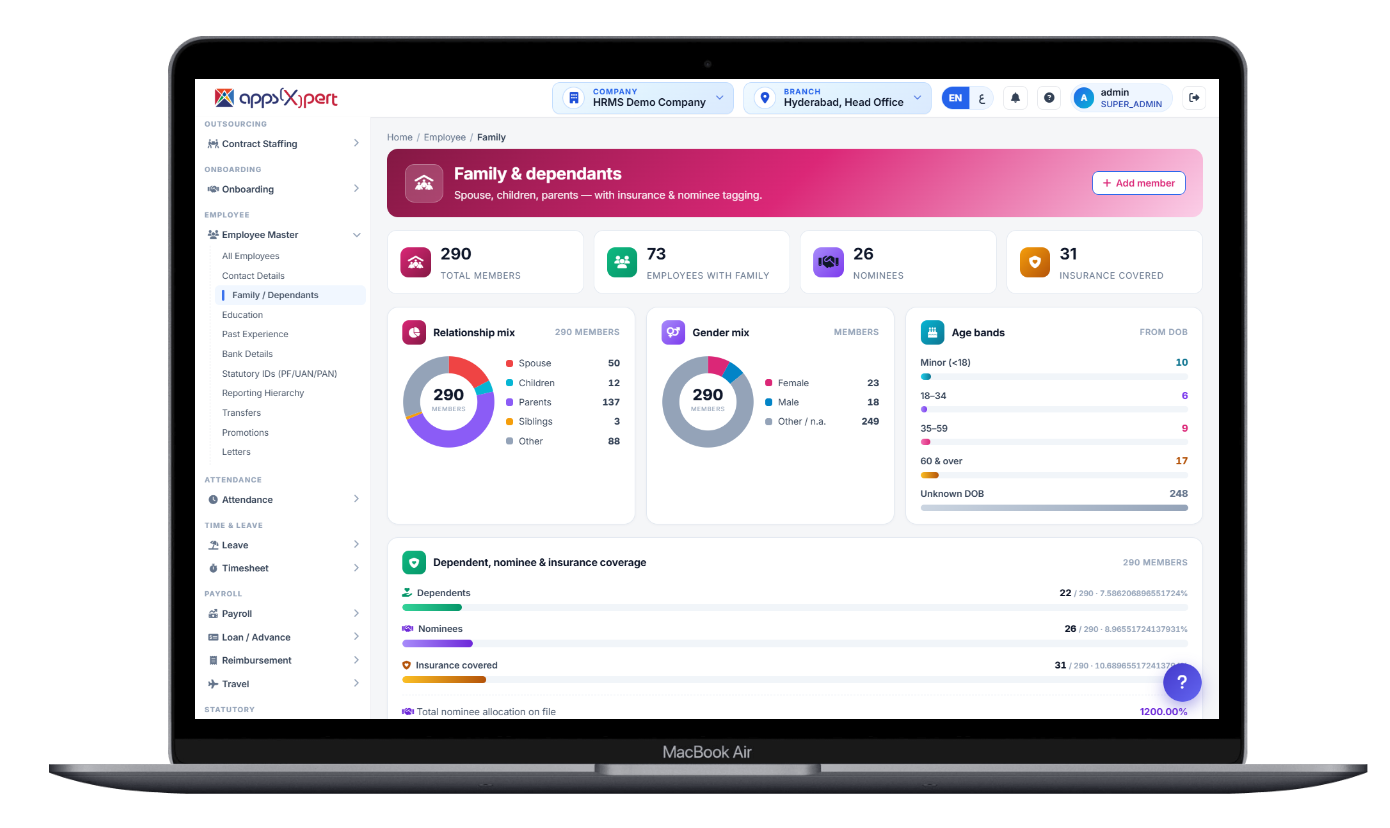
Dependants for insurance, statutory nomination and benefit eligibility.
Qualifications and prior service, feeding eligibility rules and gratuity calculation.
Account details for the salary transfer file, and the PF, ESI, PAN and UAN identifiers payroll depends on.
Who reports to whom — the structure that drives every approval route in the system.
Movements recorded with effect dates, and the letters they generate produced from templates.
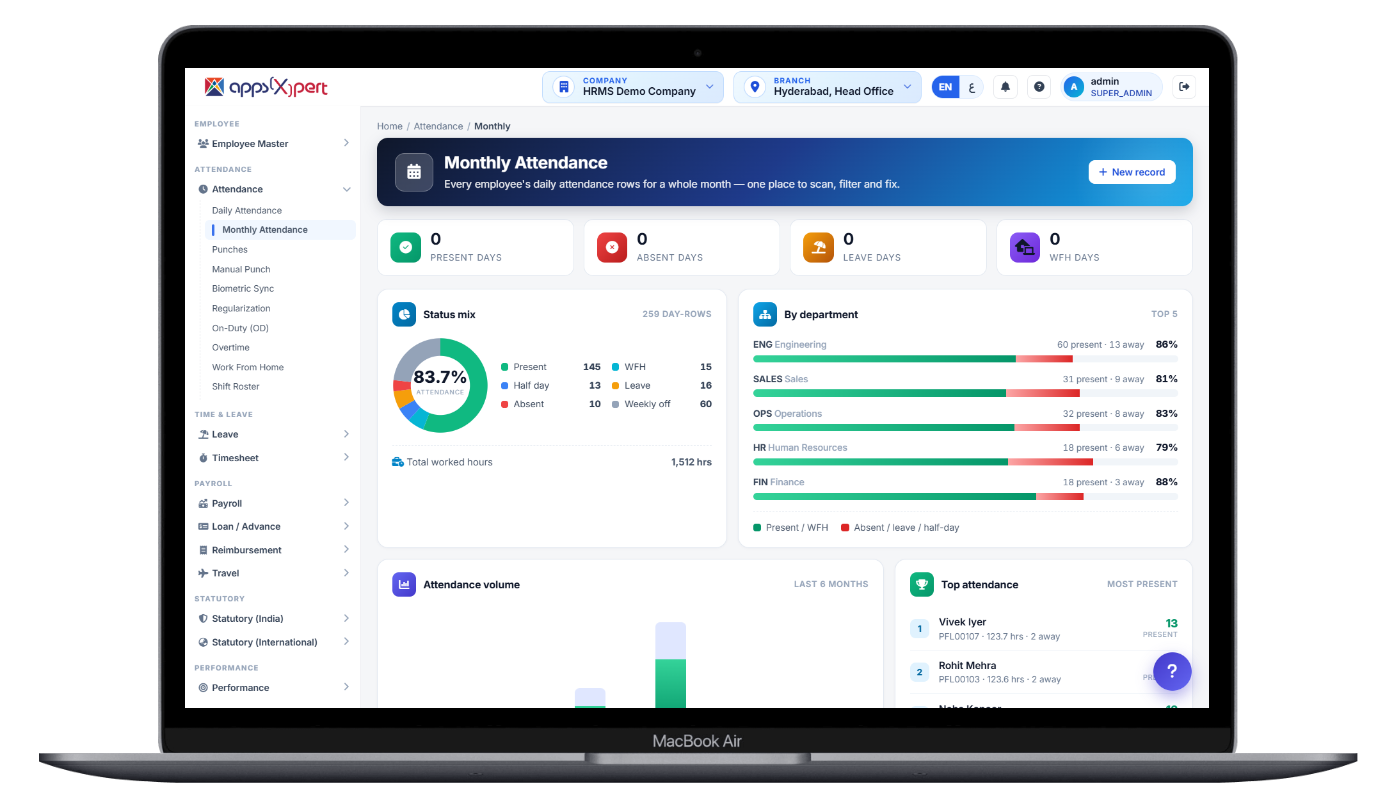
The register at both grains — the day for supervisors, the month for payroll.
Raw punches imported from the readers you already own, kept as the audit trail behind every derived figure.
Supervisor entry for a missed or failed punch, recorded against whoever entered it.
The employee's own request to correct a day, routed for approval rather than edited silently.
Time away from the office that is still working time — client visits, training, travel.
Hours beyond the shift raised for approval, and only paid once approved.
Remote days recorded as attendance, and the roster that says who is on which shift.
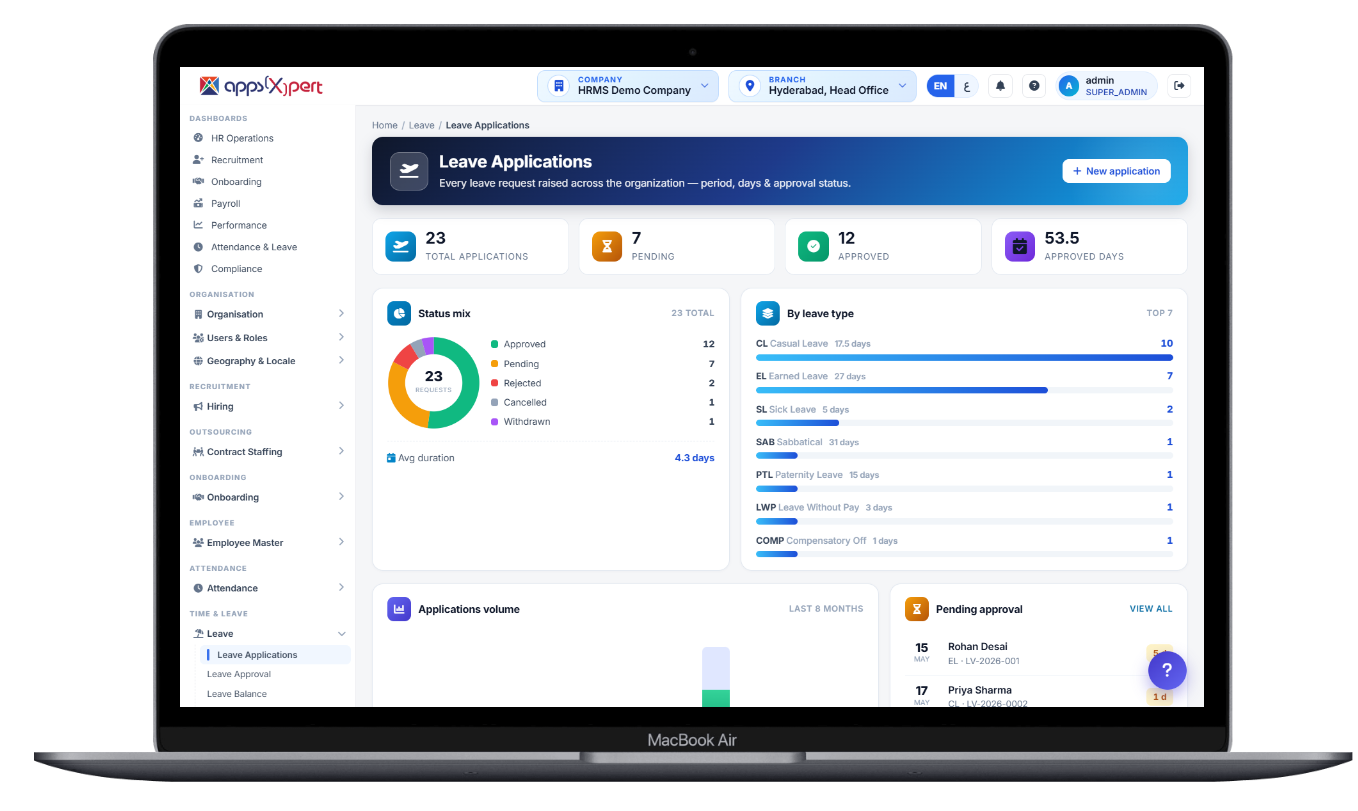
Requests routed by the approval matrix, with balance checked at the point of applying.
Live entitlement, taken, pending and available per leave type.
Approved leave withdrawn with the balance correctly returned.
Compensatory time earned for working a holiday or off day, with its own expiry.
Unused leave converted to pay, flowing into payroll rather than being handled separately.
Unpaid absence identified and passed to payroll as a deduction with an audit trail.
Leave types with their accrual and carry-forward rules, and the year-end process that applies them.
Hours booked against project and task, daily or weekly, with the period locked once approved.
Manager sign-off before hours can be billed or costed.
The structure time is booked to, with budgets to measure actuals against.
The customer a project belongs to, so utilisation and billing can be seen per account.
Approved hours turned into billable value at the applicable rate.
Billable versus non-billable by person and team — the number a services business is actually run on.
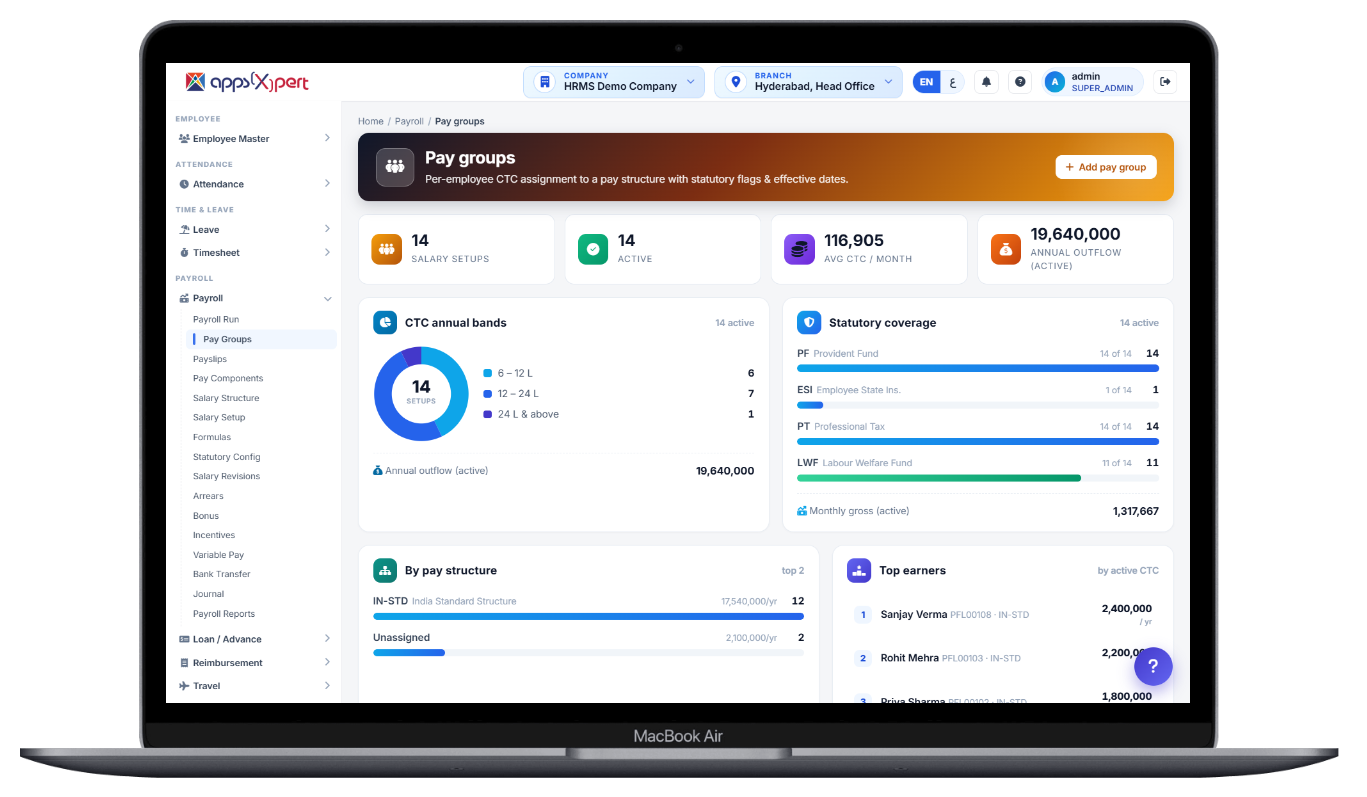
The monthly process from input lock through calculation to release, re-runnable until it is finalised.
Periods per group, so weekly workers and monthly staff can run on different cycles in one system.
Earnings, deductions and employer contributions defined as components rather than hard-coded columns.
The component breakdown per employee, effective-dated so history is preserved.
Component values expressed as configurable formulas, so a policy change is configuration rather than a code release.
Revisions with effect dates, and the arrears they generate calculated and paid automatically.
One-off and performance-linked payments processed inside the run rather than beside it.
Per-employee payslips published to self-service, with the components that produced every figure.
The salary transfer file for the bank, and the accounting journal for finance, generated from the same run.
Requests against defined loan types, routed by the approval matrix with eligibility checked.
Release recorded, then instalments recovered through payroll rather than tracked by hand.
The amortisation schedule with outstanding balance, and settlement on foreclosure or exit.
Short-term advances recovered in the next run, kept distinct from formal loans.
Expense claims with receipts, routed for approval and paid through payroll or separately.
What is claimable, up to what limit and under which policy — enforced at entry rather than at audit.
Trips requested and approved before they are booked, with the booking recorded against the request.
Money advanced before the trip, then settled against actual expenses with the balance recovered or paid.
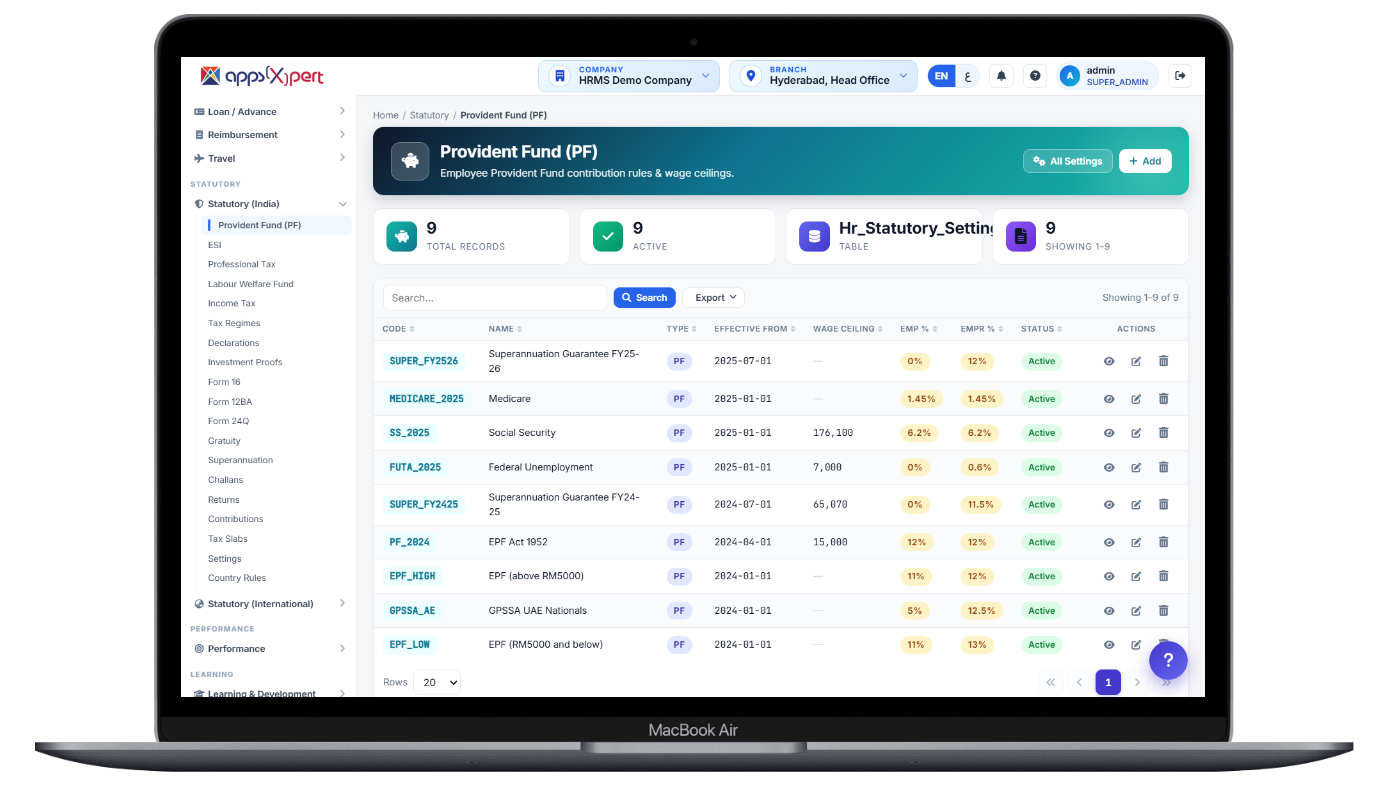
Employee and employer contributions on the configured wage base, with ceilings applied.
Contributions with coverage judged on the wage, and members moving in and out of scope handled correctly.
State-wise slabs applied by work location, including the gender-dependent exemptions some states carry.
State LWF applied in the months it is actually due rather than spread across the year.
TDS computed across the year with both the old and new regimes supported per employee choice.
Employee declarations captured, then proofs verified before the year-end recomputation.
The statutory outputs generated from the same postings the payroll ran on.
Accrual and settlement on exit, using prior service where it counts.
Contribution registers, challans and periodic returns produced in the formats the authorities expect.
EPF, SOCSO and EIS contributions on Malaysian rules.
CPF contributions and IR8A year-end reporting.
PAYG withholding and Superannuation Guarantee.
CPP contributions and T4 statements.
Income tax and social insurance deductions.
GOSI for KSA and SSS for the Philippines.
Rates, ceilings and slabs held as configuration per country, so a rate change is a setting rather than a release.
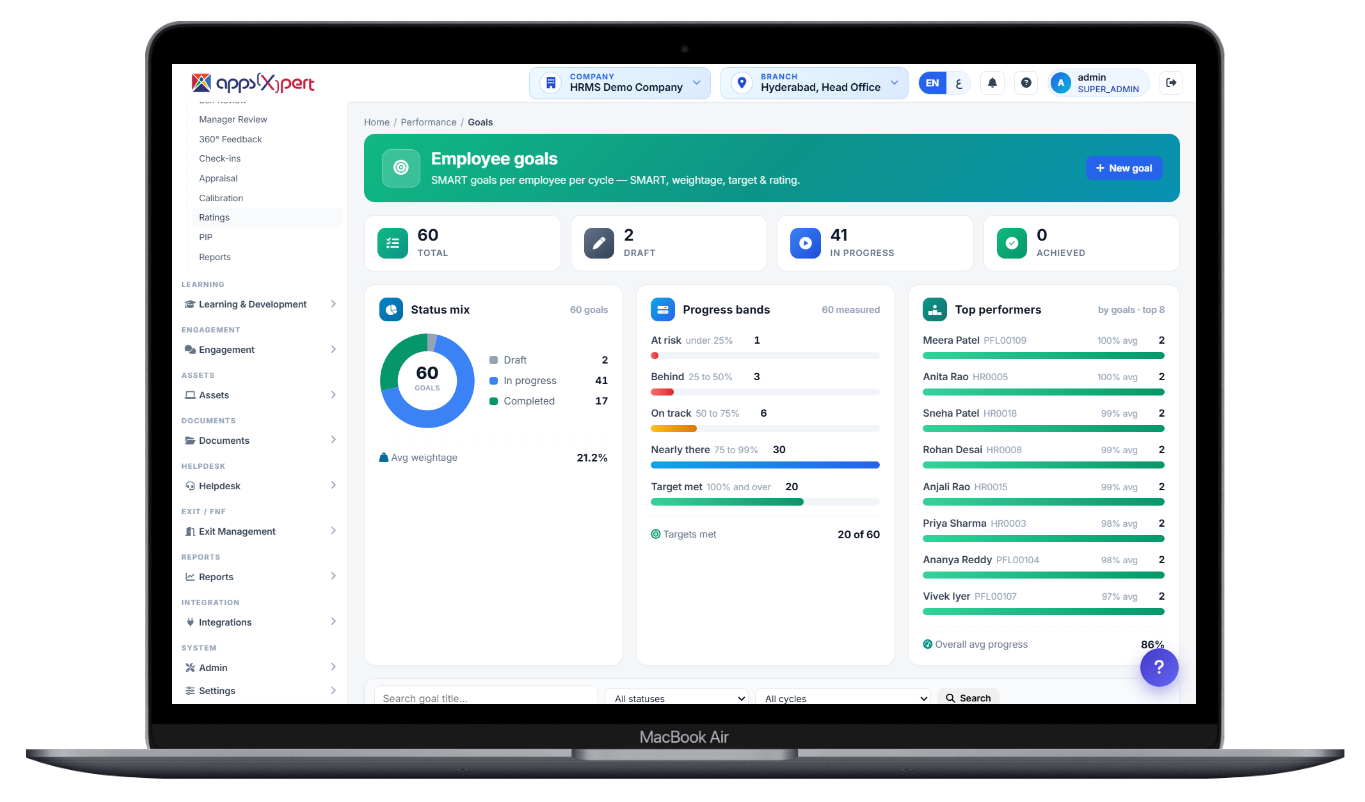
Review cycles with windows, participants and templates, run annually, half-yearly or quarterly.
Objectives cascaded from the organisation down to the individual, with measures attached.
Both sides complete against the same template, so the conversation starts from evidence.
Peer and stakeholder input, plus lightweight check-ins between formal cycles.
Moderation across managers before ratings are published, with the distribution visible.
Outcomes that flow into payroll as revisions, and improvement plans tracked for those who need them.
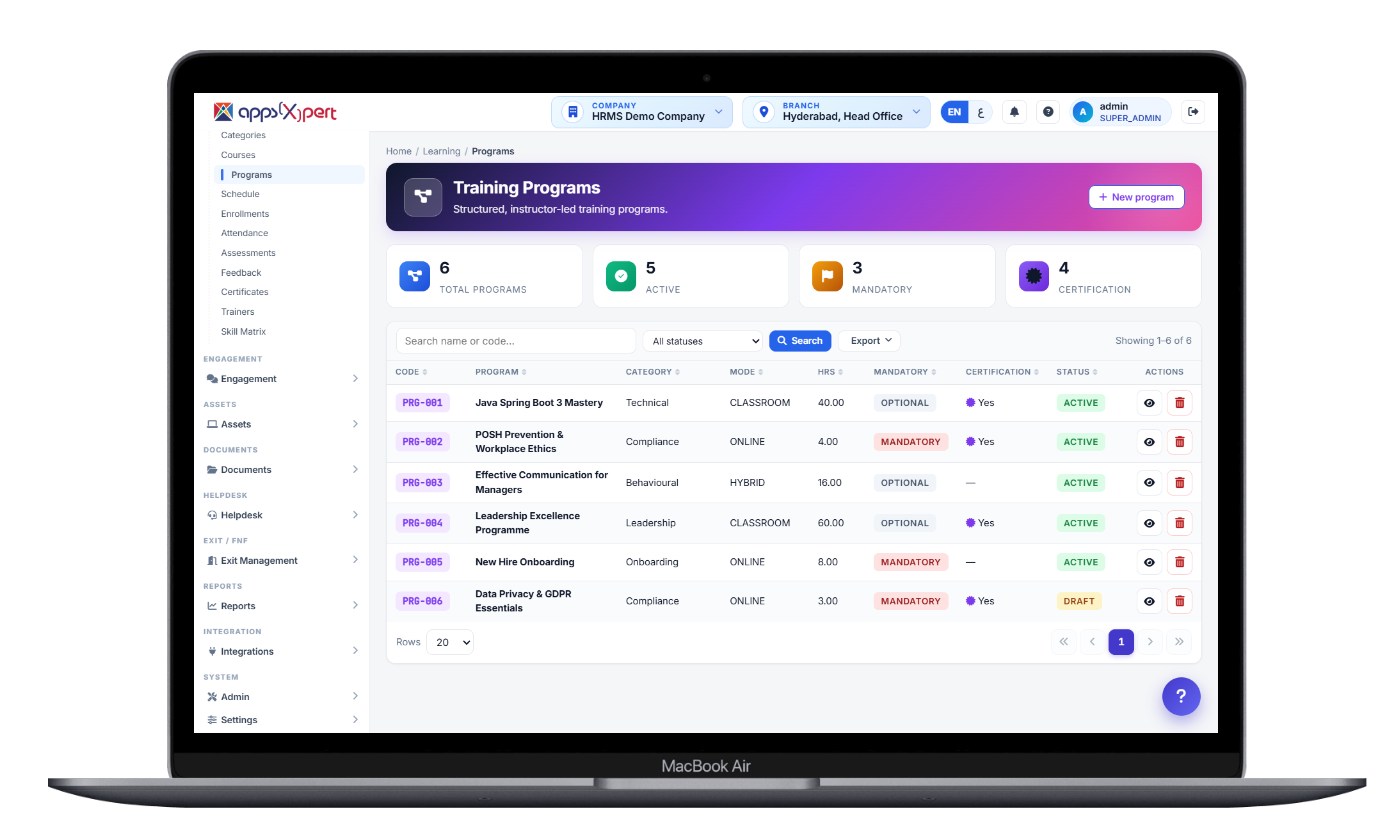
The training catalogue, the programmes built from it and the sessions scheduled.
Who attended, how they scored and the certificate issued, with feedback captured per session.
Capability mapped across the workforce, showing the gaps training is meant to close.
Company communication published to the portal instead of scattered across email.
Pulse checks and engagement surveys with results reported back.
Peer and manager recognition, plus birthdays, anniversaries and company events.
Company equipment registered by category and issued to a named employee.
Movement between people, return on exit, and service history — with periodic audit.
The document library staff are expected to read, with employment contracts held against the record.
Letters generated from templates, and proof that a policy was read and accepted.
An HR helpdesk with categories, SLAs, a knowledge base, and a separate confidential channel for grievances.
Resignation recorded with the notice the contract requires, and shortfall recovered at settlement.
Structured exit feedback captured and reportable, so attrition reasons are data rather than anecdote.
Department-by-department sign-off and formal handover before the record is closed.
Issued equipment returned and reconciled, with anything outstanding priced into the settlement.
Final dues computed — salary, leave encashment, gratuity, loan recovery and notice adjustment in one statement.
Generated from templates once settlement completes, not typed by hand.
Involuntary exits, retirements, warnings and disciplinary actions handled as recorded processes.
Workforce composition across every dimension you maintain, at any point in time.
The registers and summaries payroll, audit and managers each need.
The full register plus cost by department, cost centre and location.
Contribution and filing reports in the formats the authorities expect.
Turnover and its reasons, hiring funnel metrics and rating distribution.
Reports built to your own definition and delivered on a schedule rather than pulled manually.
Biometric devices, bank payment APIs, accounting systems such as Tally and Zoho, and email or SMS gateways.
Approval routing, email templates, notification rules and document numbering, all configured rather than coded.
Who changed what and when, plus scheduler, system health, import/export and backup and restore.
Payslips, tax declarations, leave, attendance regularisation, reimbursement claims and personal details — handled by the employee rather than by an HR inbox.
Approvals, team attendance and leave, appraisal actions and team reports in one place for the line manager.
Per-user profile and preferences, plus company branding, locale and feature flags for the administrator.
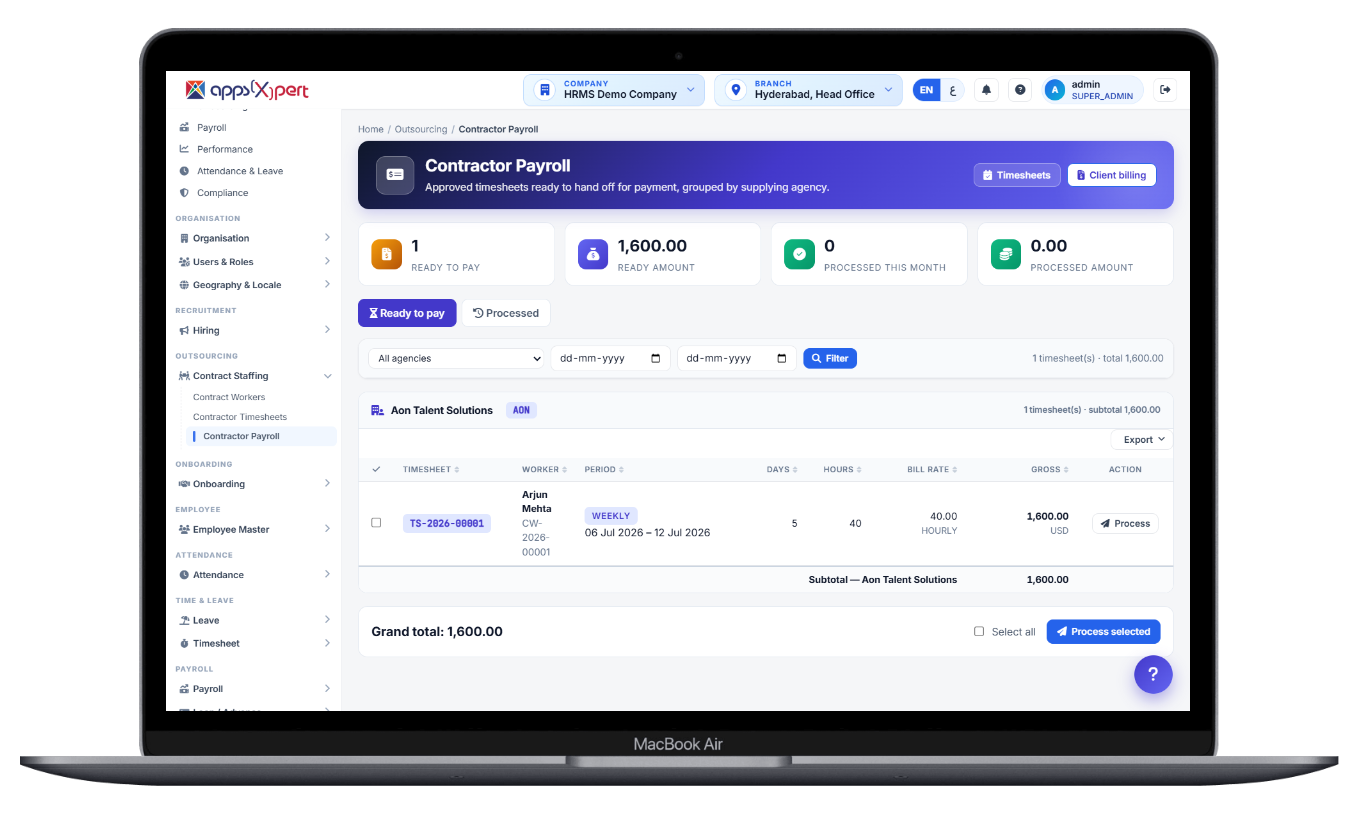
Real screens from the product — recruitment and onboarding, attendance and leave, payroll and statutory compliance, performance, learning, assets, helpdesk and exit, all on one connected system. Click any screen to view it full size.
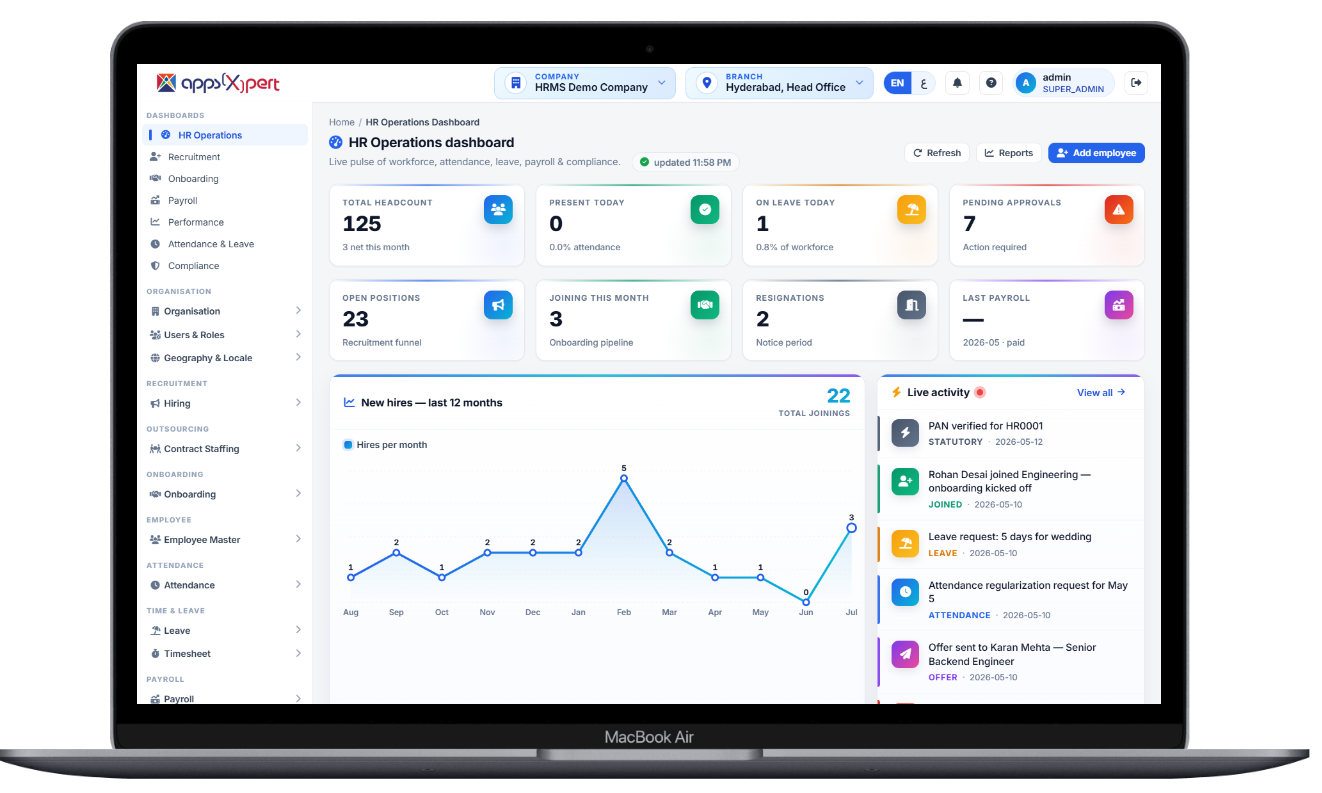
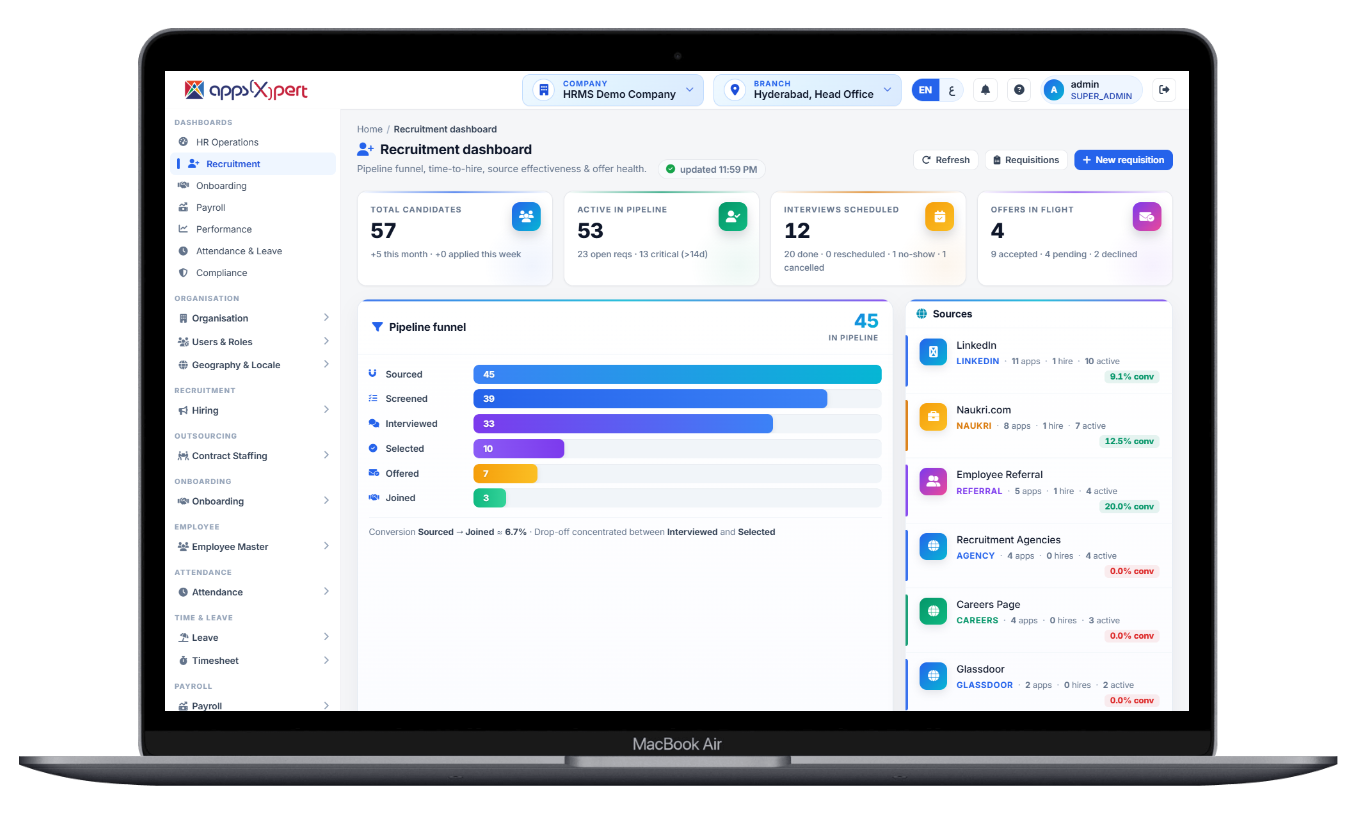
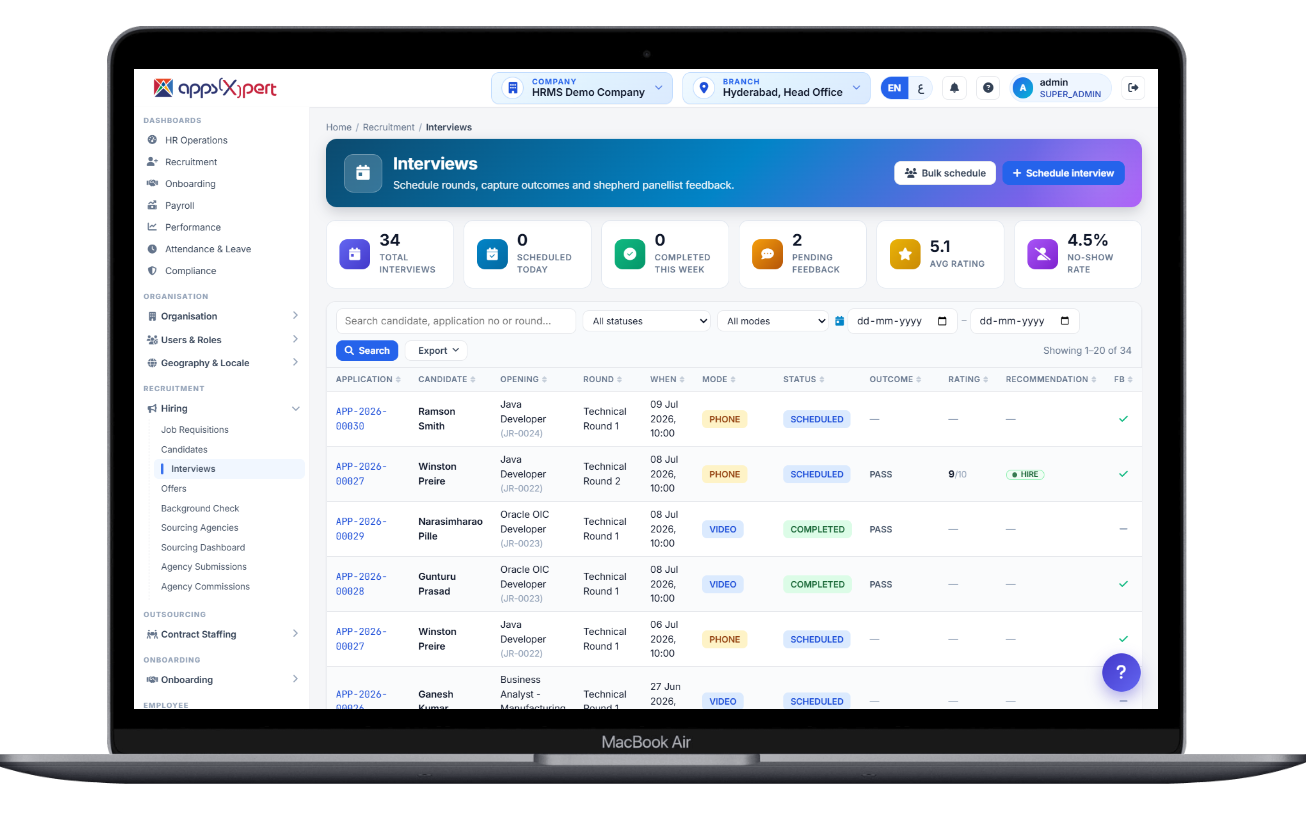
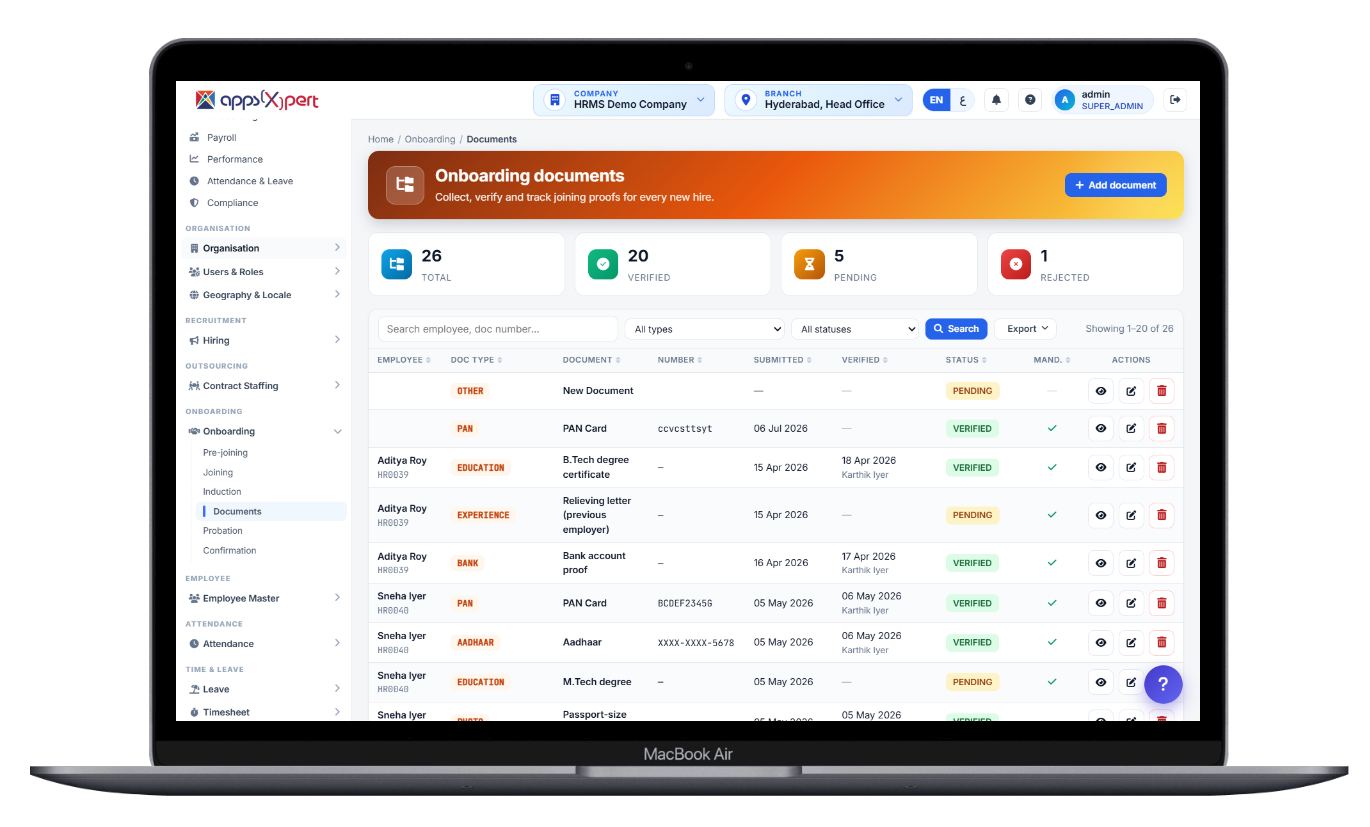
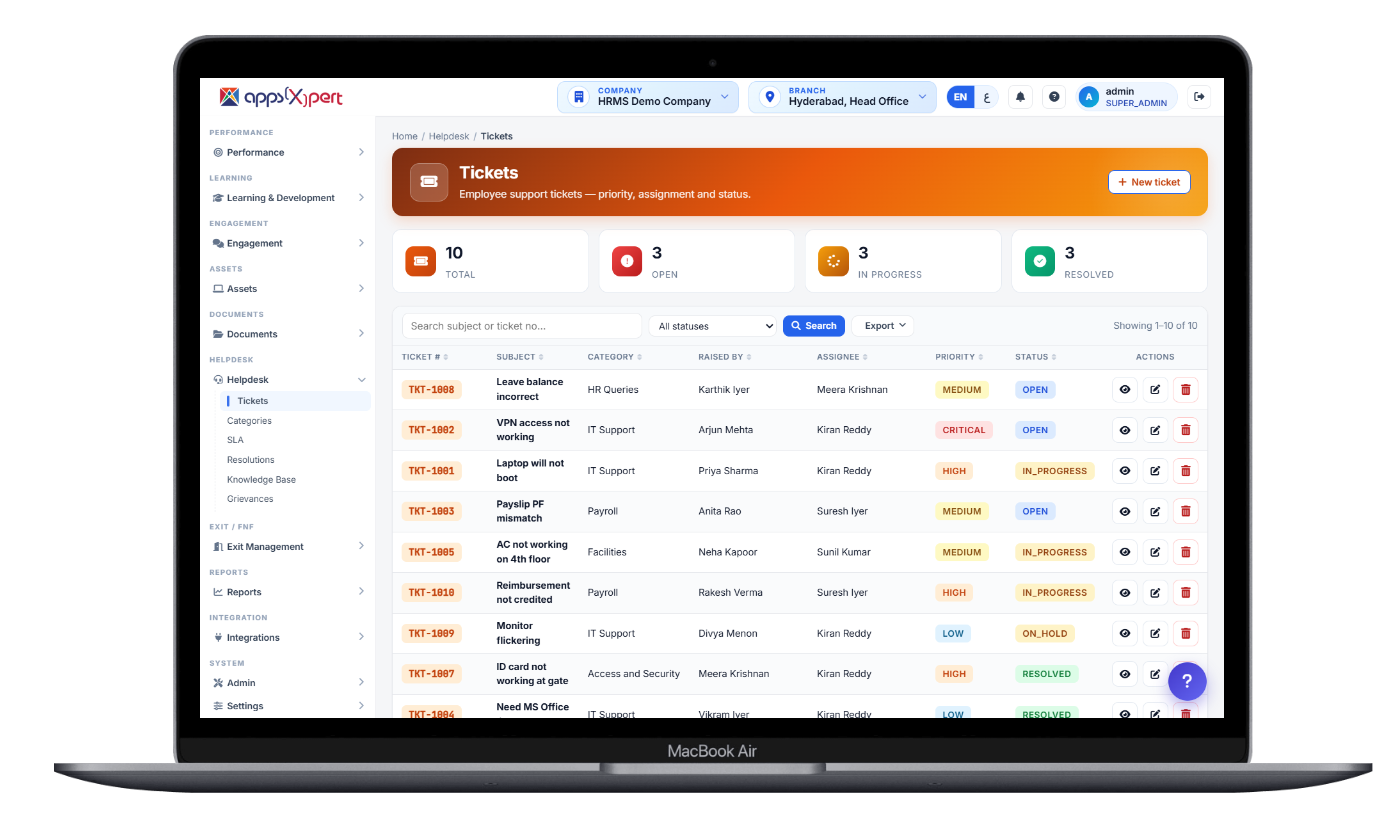
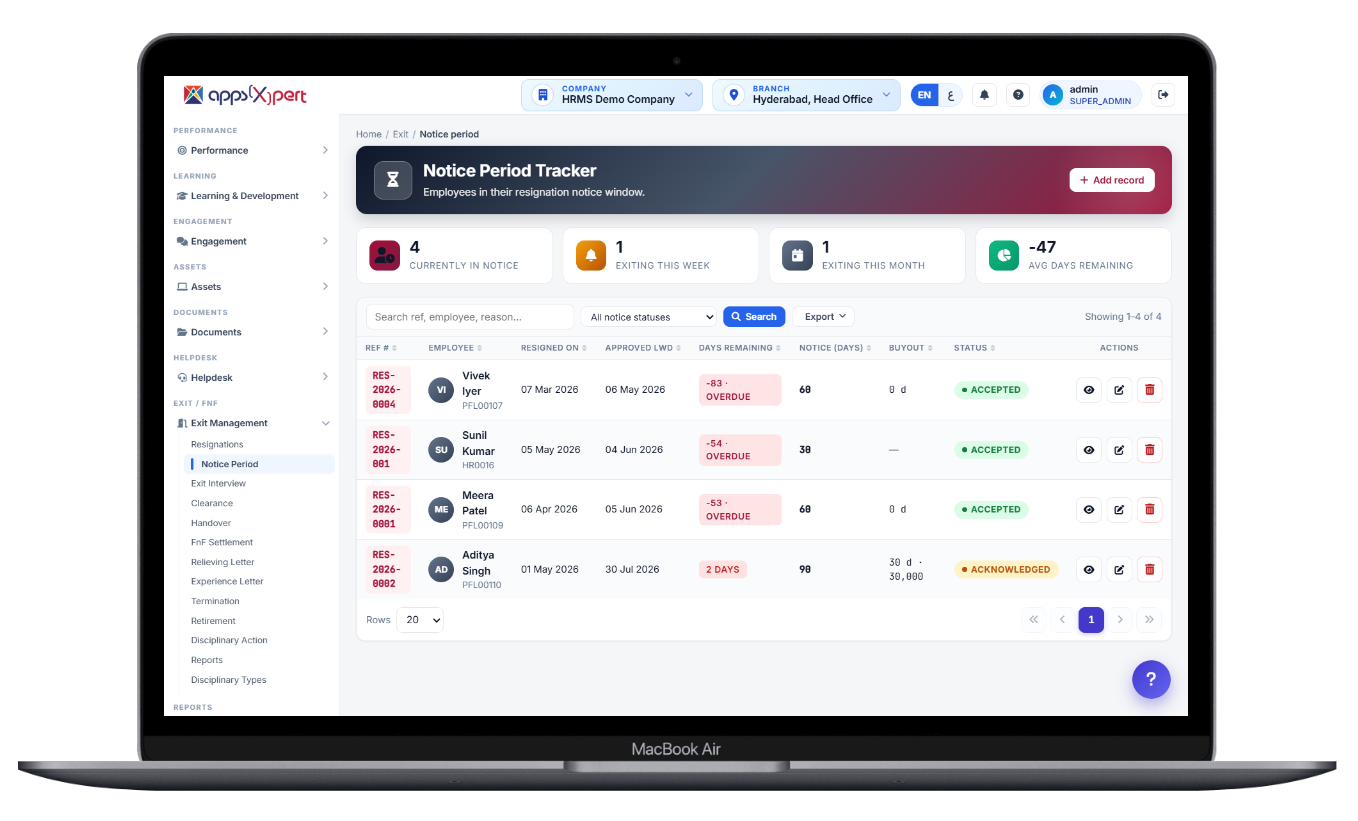
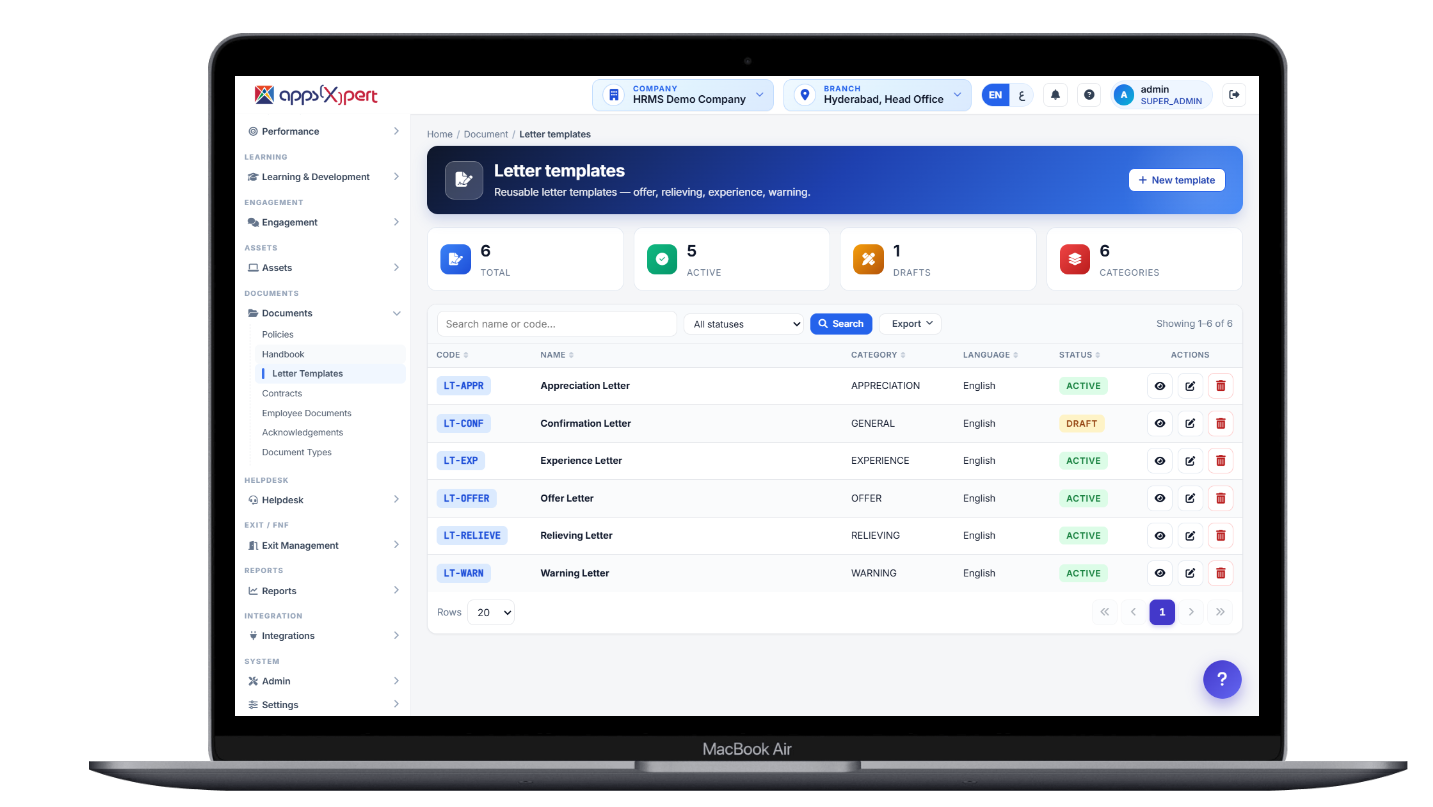
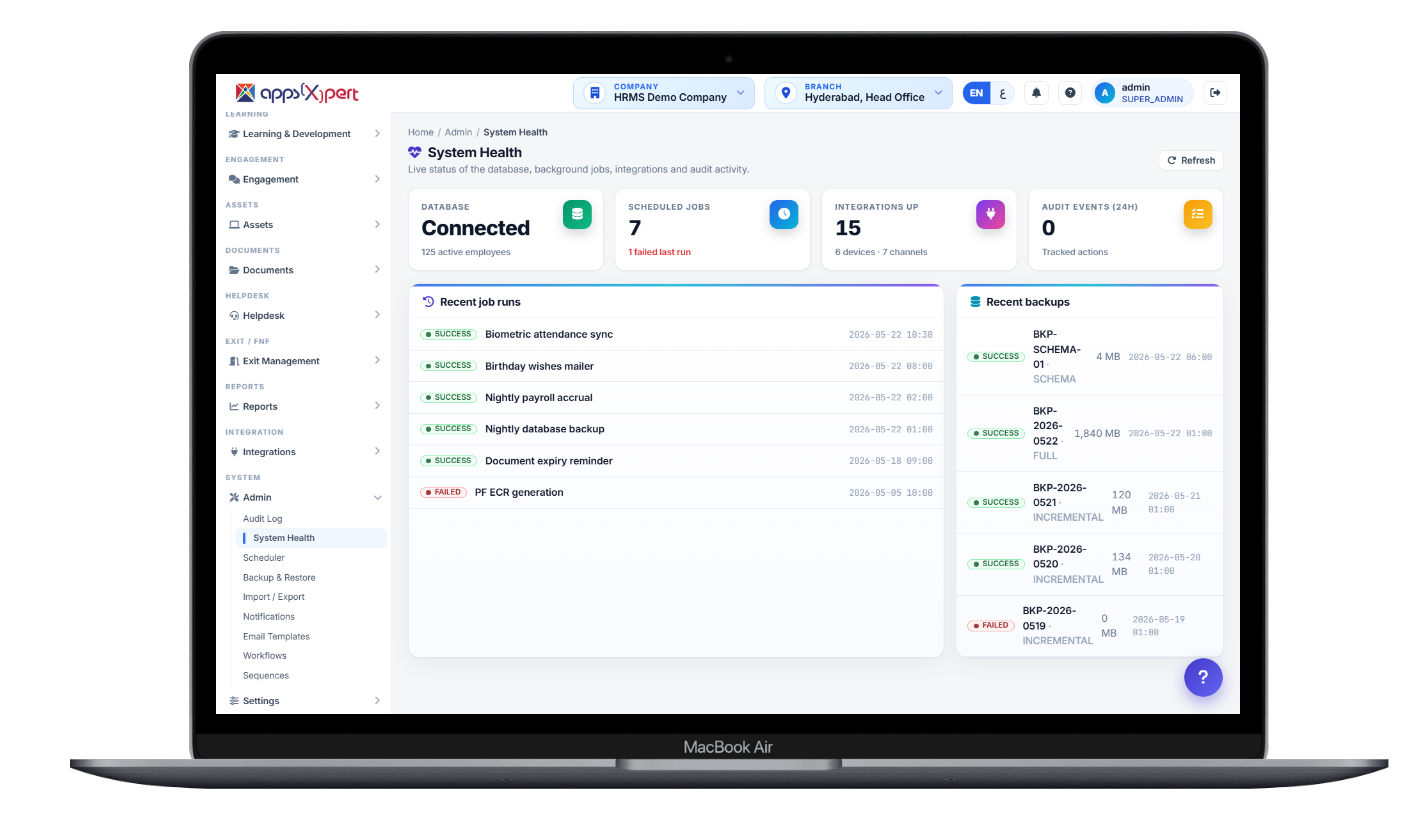
"We go beyond software to ensure your HRMS delivers measurable people outcomes. With proven rollouts across industries, our team blends HR domain knowledge, payroll accuracy and technical depth. From affordable implementation to a fully managed payroll bureau, we focus on creating sustainable value at every stage. Partner with us to modernise HR operations, pay people correctly on time, and scale your workforce with confidence."
Every stage from candidate application to final settlement is digitised, tracked with audit trails, and governed by configurable approval workflows.
Requisition, job posting, screening, interviews, offers & background checks
Pre-joining, induction, buddy, asset issue, documents & probation
Attendance, leave, payroll, timesheet, loans, travel & reimbursement
Performance reviews, OKR goals, training, skill matrix & certifications
Surveys, recognition, events, announcements & helpdesk support
Resignation, notice, exit interview, clearance, FnF & relieving letter
We deliver HRMS and payroll solutions across industries — each with its own shift patterns, statutory obligations and workforce mix.
Shift rosters, overtime rules, contractor labour and factory-floor biometric attendance.
Multi-site workforces, driver rosters and attendance captured away from a desk.
Field-force attendance, regulated training records and certification tracking.
Store rosters, part-time staff, seasonal hiring peaks and high-turnover onboarding.
Site-wise labour, contractor payroll, safety induction and statutory site records.
Seasonal workforces, daily-wage payroll and location-based attendance capture.
Academic and non-academic staff, timetable-linked attendance and increment cycles.
Plant and dealer network staffing, skill matrices and technician certification.
24×7 shift rotation, on-call allowances, licence renewals and duty rosters.
Billable timesheets, project allocation, utilisation tracking and client billing.
Rotating shifts, tips and service charge distribution, and high seasonal churn.
Field crews, hazardous-duty allowances and mandatory safety certification.
Move routine HR requests off the HR desk and onto the phone every employee already carries — with the same live data managers see on the web.
A single mobile app on Android and iOS covers the everyday HR cycle — marking attendance, applying for leave, viewing payslips and claiming expenses — with manager approvals in the same app. One login, one live connection to the HRMS, no separate portals.
Punch in and out with geo-tagging and selfie verification for field and remote staff, synced instantly to the attendance register.
Check balances, apply for leave and get manager approval on the phone — with the balance updated the moment it is sanctioned.
View and download payslips, tax statements and Form 16 without raising a request to the HR team.
Capture bills with the camera, submit travel and reimbursement claims, and track approval and payment status.
Attendance flows in from the devices your people already use, and payroll output flows out to banks and your accounting system — automatically, with no re-keying.
The HRMS ships with a documented REST API, so connecting a biometric brand, bank format or ERP we have not integrated before is straightforward — no core changes, no middleware licence. Authentication, rate limiting and retry handling are built in, and every exchange is logged for audit and troubleshooting.
Because HR software should reduce work, not create it. We make the rollout pay for itself.
Forms and filters are dead UX. We embed an AI conversation layer into the apps we ship — so HR teams and employees get answers, charts and actions in seconds, without learning your menu tree.
User: Who is on leave in the Guntur office next week?
AI: Six people — three approved, three pending your approval.
User: Draft a relieving letter for Rahul Verma
AI: Done — drafted from his joining date, designation and last working day, sent to HR review queue. Open draft →
Every page we build now ships with an optional AI assistant that reads your real data — attendance, payroll, leave balances, tickets — and answers in natural language. No new tab, no separate chatbot tool. Just a conversation, where the work happens.
Behind the scenes we also build with Claude — pairing it on architecture, code generation, test writing and migrations. The same AI that writes our code now lives inside your app to serve your employees.
Your user types — or speaks — a plain English question or instruction inside your app.
It understands the request, pulls exactly the right information, and stays within each person's access.
The answer lands as a chart, table, summary or one-click action — right inside your app, not in a side panel.
NDA-first · 30-minute strategy call · we ship a working prototype in two weeks
Employee records, salary data and statutory filings are among the most sensitive information a business holds. We protect them with legally binding agreements and strict confidentiality protocols on every engagement.
Every engagement starts with a signed NDA — before any discovery call, demo or data exchange. Your employee records, payroll data and business logic stay confidential.
You own 100% of the source code and intellectual property. No vendor lock-in, ever.
We build trust through transparency, reliable delivery, and ongoing support that grows with you.
We deliver a working Proof of Concept before any financial commitment. See your own employee data on real screens, validate the payroll calculation, and decide with confidence — no upfront charges, no lock-in contracts.
We build a functional prototype with your real employee and payroll data in just 2-3 weeks — completely free of charge.
Get full source code and IP ownership of your project for an additional fee. No vendor lock-in — you control your software.
Not satisfied? Walk away with zero obligation. No penalty, no questions asked. The POC is yours to keep either way.
We don't believe in trapping clients. Flexible engagement models — fixed price, T&M, or dedicated team. You choose.
Ready to see your HRMS come to life — for free?
Schedule Free ConsultationNo credit card required • No commitment • Response within 24 hours
Let us help you modernise hiring, attendance, payroll and compliance.
