One system for finance, inventory and the warehouse floor — not an ERP with a WMS bolted on afterwards.
Warehouse operations fail when the stock system and the finance system disagree. Our ERP ships with warehouse management inside it — receiving, putaway, picking, packing and dispatch posting to the same ledger as every purchase and sale, so the stock figure and the accounts never need reconciling.
Modern businesses need more than just software — they need an integrated ERP strategy that connects people, processes and inventory end-to-end.
Our ERP & Warehouse Management experts help organizations simplify operations, improve fulfillment performance, and adopt scalable ERP + WMS solutions that grow with the business. From system assessment and WMS design to deployment and continuous optimization, we provide a practical, low-risk approach that accelerates adoption and ensures your technology investment delivers measurable operational value. Whether you are replacing legacy ERPs, automating warehouses, or expanding omnichannel fulfillment, our consultants bring deep industry experience and hands-on delivery to achieve results — faster, smarter, and cost-effectively.
Every business faces unique supply chain and inventory challenges, which is why we deliver tailor-made and affordable services aligned with your goals. By leveraging real-time inventory insights, automation, and AI-assisted demand forecasting, we help you reduce stockouts, shorten order cycles, and lower operating costs. Beyond implementation, we form long-term partnerships — offering managed services, change management, and continuous improvement initiatives that empower your teams to maximize ERP and WMS value. With our value-driven, cost-effective solutions, your ERP landscape will not only run efficiently but also drive sustainable supply chain innovation and growth.
We modernize your operations — from ERP core processes to warehouse execution — with cost-effective, industry-tailored solutions that ensure operational excellence.
Deploy core ERP modules — Finance, Inventory, Purchasing, Sales — quickly and securely with minimal disruption to daily operations.
Implement WMS capabilities for receiving, putaway, picking, packing and shipping — optimized for throughput and accuracy.
Connect ERP and WMS with eCommerce, TMS, POS and 3PLs using secure, reliable integrations built for scale.
Choose cloud, on-premise or hybrid models that deliver enterprise-grade security, resilience, and cost-effectiveness.
A robust platform packed with advanced capabilities to streamline operations, enhance collaboration, and drive business growth.
Manage multiple legal entities in one system with financial reports.
Oversee branch operations centrally with full transparency and control.
Empower global teams with multilingual support across the system.
Process international transactions with automated currency handling.
Automate approvals, tasks, and escalations with rule-based workflows.
Ensure secure access with role permissions and user-level control.
Store, track, and attach documents directly to transactions.
Easily connect with eCommerce, CRM, banking, and logistics systems.
Complete traceability of transactions with user and timestamp logs.
Dynamic dashboards and analytics for data-driven decisions.
Stay connected on-the-go with mobile-friendly access and apps.
Flexible deployment on cloud or on-premise based on business needs.
We combine deep ERP and warehouse expertise with an affordable delivery model so you capture measurable operational benefits — without overspending.
One integrated application rather than a bundle of separate products — every module below shares the same item, partner and account masters, posts to the same ledger, and runs through the same approval workflow, role matrix and audit log. These are the areas we configure, extend and support in production.
The whole business on one board — revenue, purchases, stock value, receivables and payables, with drill-through into the documents behind every figure.
Pipeline value by stage, conversion rate, activities due and forecast against target for the sales team.
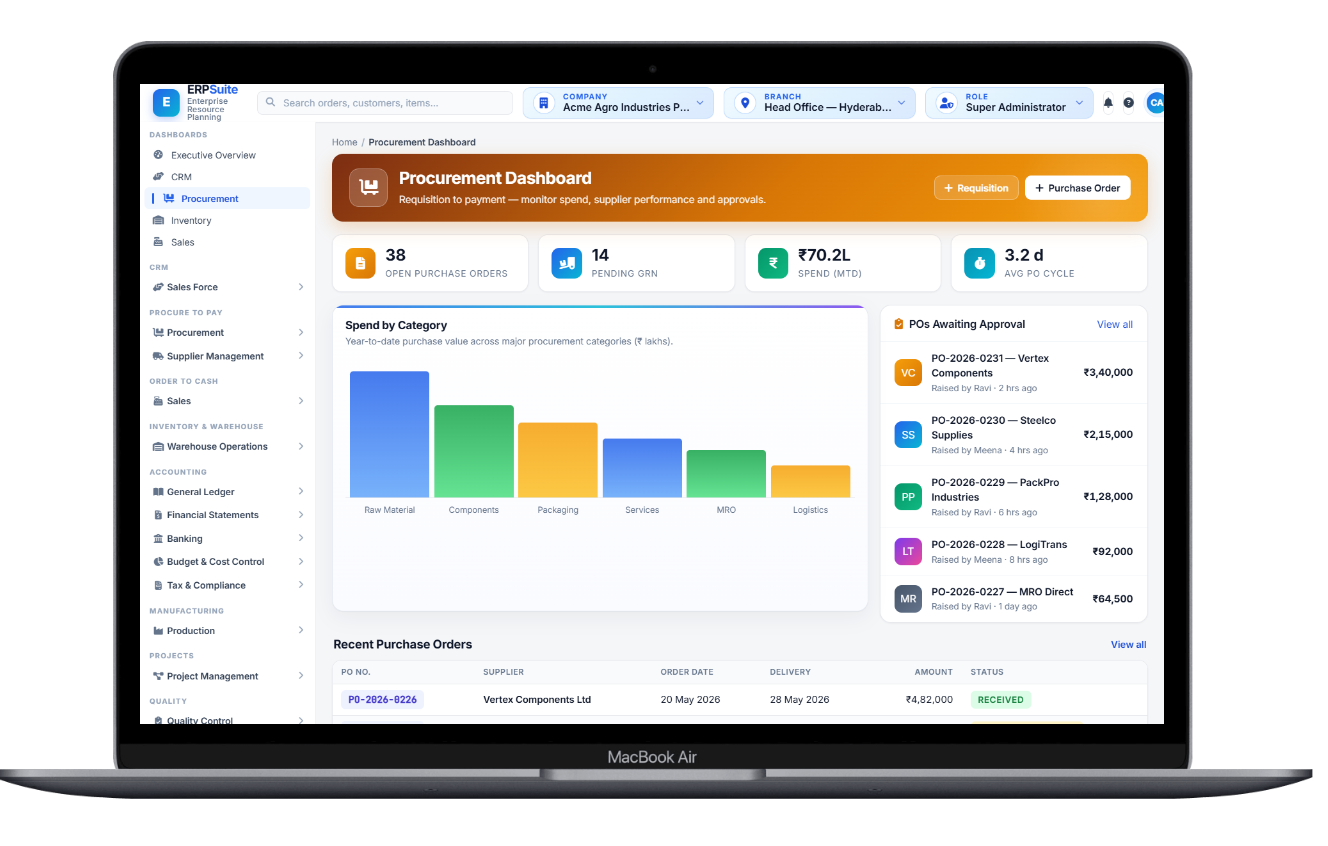
Open requisitions, pending purchase orders, goods awaiting receipt and supplier spend concentration.
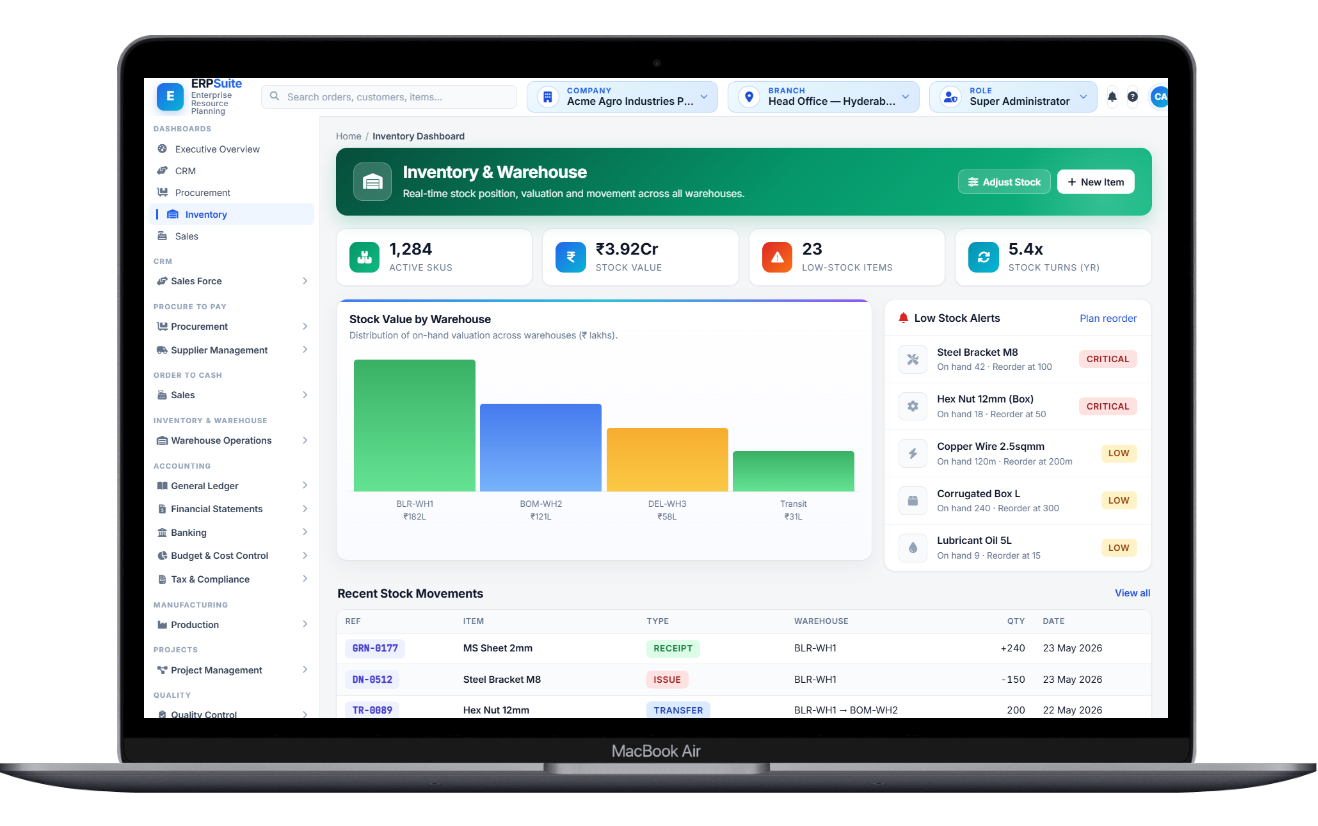
Stock on hand and its value, items below reorder level, slow-moving lines and warehouse utilisation.
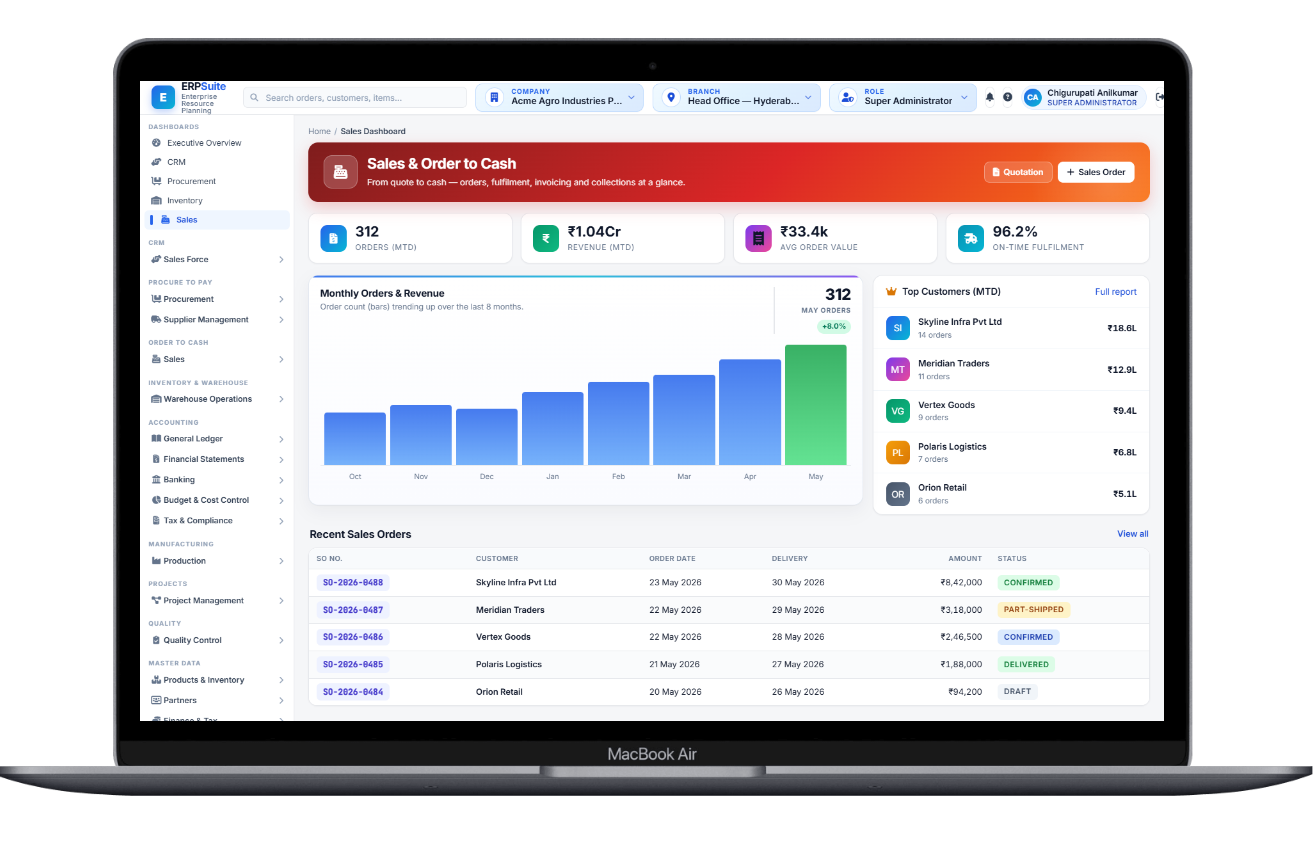
Order intake, deliveries due, invoices raised and collections outstanding against the current period.
Capture and qualify enquiries with source tracking, assignment and follow-up, converting a qualified lead into an account, contact and opportunity in one step.
Deals with expected value, close date, stage and probability, so a forecast is derived from real records rather than assembled in a spreadsheet.
Drag-and-drop board of open opportunities by stage — the fastest way for a sales manager to see where deals are stalling.
The company record that ties CRM to trading — an account here is the same partner the sales order and invoice are raised against.
People within each account with role, reporting line and communication history.
Priced proposals with validity, terms and revisions, convertible straight into a sales order without re-keying a line.
Calls, meetings, emails and tasks logged against a lead, opportunity or account, with follow-up reminders.
Marketing campaigns with budget, target segment and the leads they generated, so spend can be judged against pipeline created.
Post-sale support issues raised against a customer and tracked to resolution, keeping service history beside the trading history.
Weighted and committed forecasts by period, owner and territory, rolled up for review.
Internal demand raised by department or cost centre and routed for approval before any commitment to a supplier exists. Approved requisitions convert directly into a purchase order.
One RFQ issued to several suppliers from a single requisition, so competitive buying is the default rather than an exception.
Responses captured against the RFQ with a side-by-side comparison on price, lead time and terms before the award decision.
Approved orders with delivery schedules, tax treatment and terms, tracked from issue through partial receipt to closure.
Receipt against the order with quantity, batch and quality status — including putaway to the destination bin, so receiving and warehouse are one step.
Rejected or excess stock returned to the supplier with the inventory and accounting reversal handled together.
Supplier invoices matched three-way against the purchase order and goods receipt, with variances held rather than quietly posted.
Payment against bills with allocation, part payment, holds and remittance, posting to the bank and supplier ledgers in one transaction.
Claims raised on a supplier for shortage, damage, rate difference or rejected goods, adjusting the payable.
Scoring on delivery performance, quality acceptance and price competitiveness, so renewal is an evidenced decision.
Rate contracts and blanket agreements with validity and agreed pricing that purchase orders draw from automatically.
Customer proposals with pricing, discounts, tax and validity, convertible to an order without re-entry.
Confirmed demand with delivery schedule and credit check, driving allocation, picking and invoicing downstream.
Picking, packing and dispatch against the order, releasing stock from the correct bin and generating the delivery document.
Raised from the order or the delivery, with tax computed per line and the receivable posted automatically.
Customer payments allocated against open invoices, with part settlement, advances and on-account handling.
Rate corrections, discounts and returns credited to the customer with the ledger adjusted in the same step.
Goods returned by the customer taken back into stock at the right valuation, with the credit raised against the original invoice.
Live quantity by item, warehouse and bin, separating what is physically present from what is already committed to open orders.
Every inward, outward and internal movement as an auditable ledger — the record that explains why a quantity changed.
Movement between warehouses or bins with in-transit visibility, so stock is never invisible while it is on the road.
Cycle-count and physical-verification corrections with a reason code and approval, posting the write-on or write-off to the right account.
Batch and serial tracking with manufacture and expiry dates, giving full traceability from goods receipt to the customer who received it.
Reorder levels, safety stock and lead times turned into suggested purchase requisitions before a line runs out.
Inventory valued on the configured method, reconciling to the stock account in the general ledger rather than sitting beside it.
Manual and adjusting entries with validation that debits equal credits, routed for approval before posting.
Journals by type — sales, purchase, cash, bank, contra and general — each with its own numbering series and controls.
Every posting from every module lands here automatically, so the ledger is never a separate reconciliation exercise.
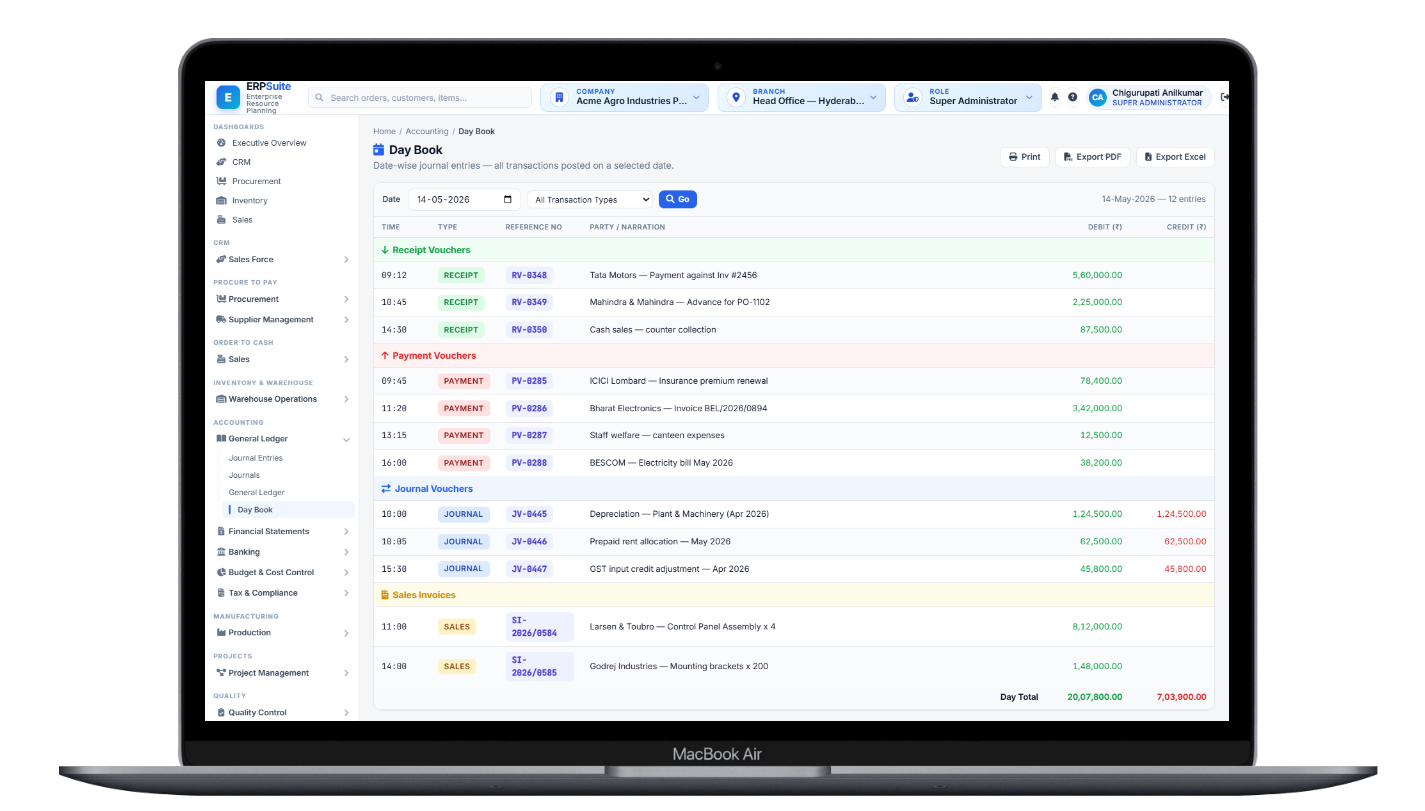
All transactions for a date or range in one chronological view, the way an accountant actually checks a day's work.
Balances by account and period with drill-through to the entries behind each line.
Assets, liabilities and equity generated from live postings for any period, with comparatives.
Income and expenditure by period, cost centre or branch, so profitability is visible per unit rather than only in aggregate.
Operating, investing and financing movements derived from the same postings as the other statements.
Bank and cash books with opening balances, currencies and the ledger accounts they post to.
Statement lines matched against system entries with rules for the obvious ones, leaving only genuine exceptions to review.
Budgets by account, period, cost centre or project, forming the baseline every variance report is measured against.
Distribution of an approved budget across departments, periods or sub cost centres, with revisions tracked.
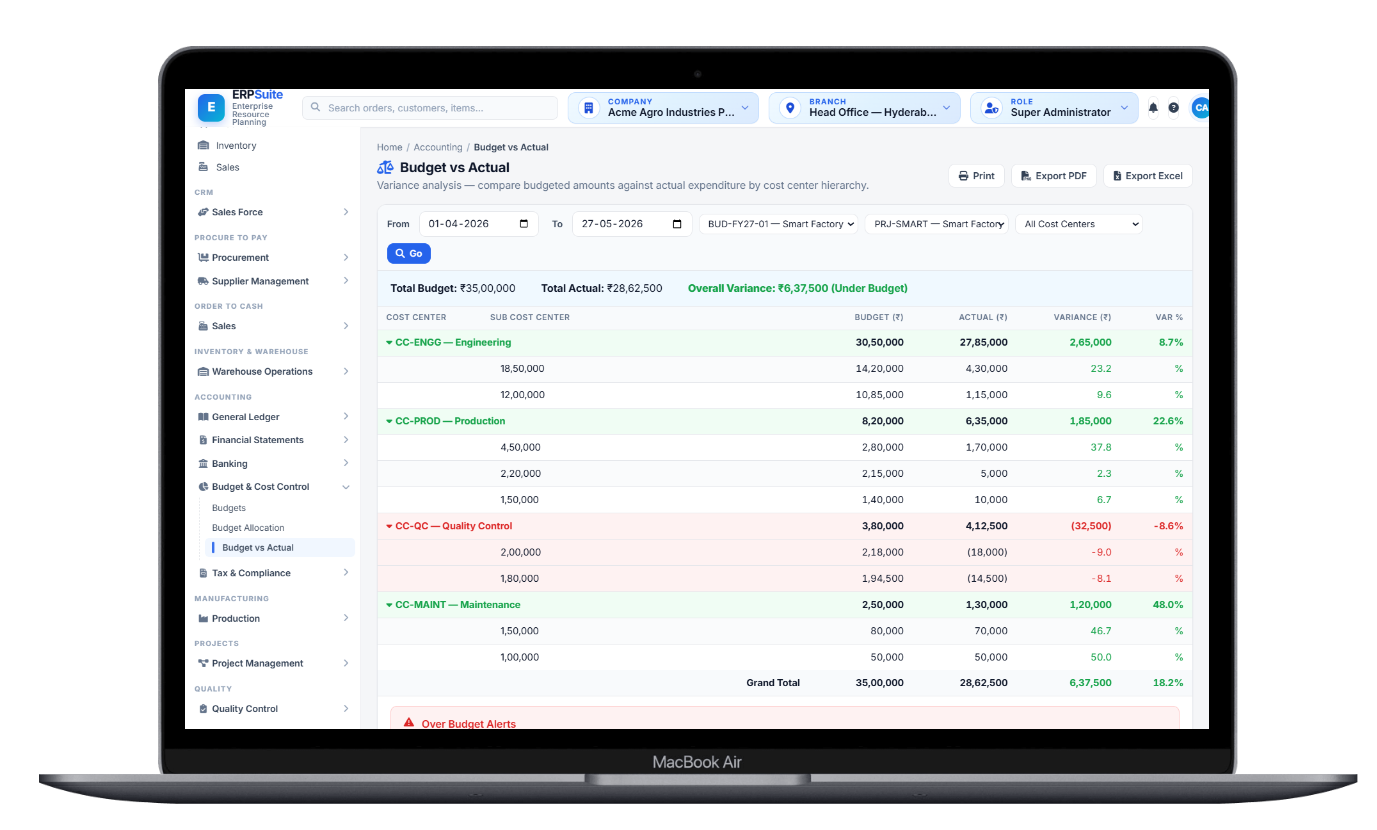
Live variance with drill-through to the transactions responsible, so an overrun can be explained the same day.
Tax periods prepared and filed from posted transactions, with the supporting summaries attached to the filing.
Financial years and periods with open, closed and locked states, so a posted period cannot be quietly altered.
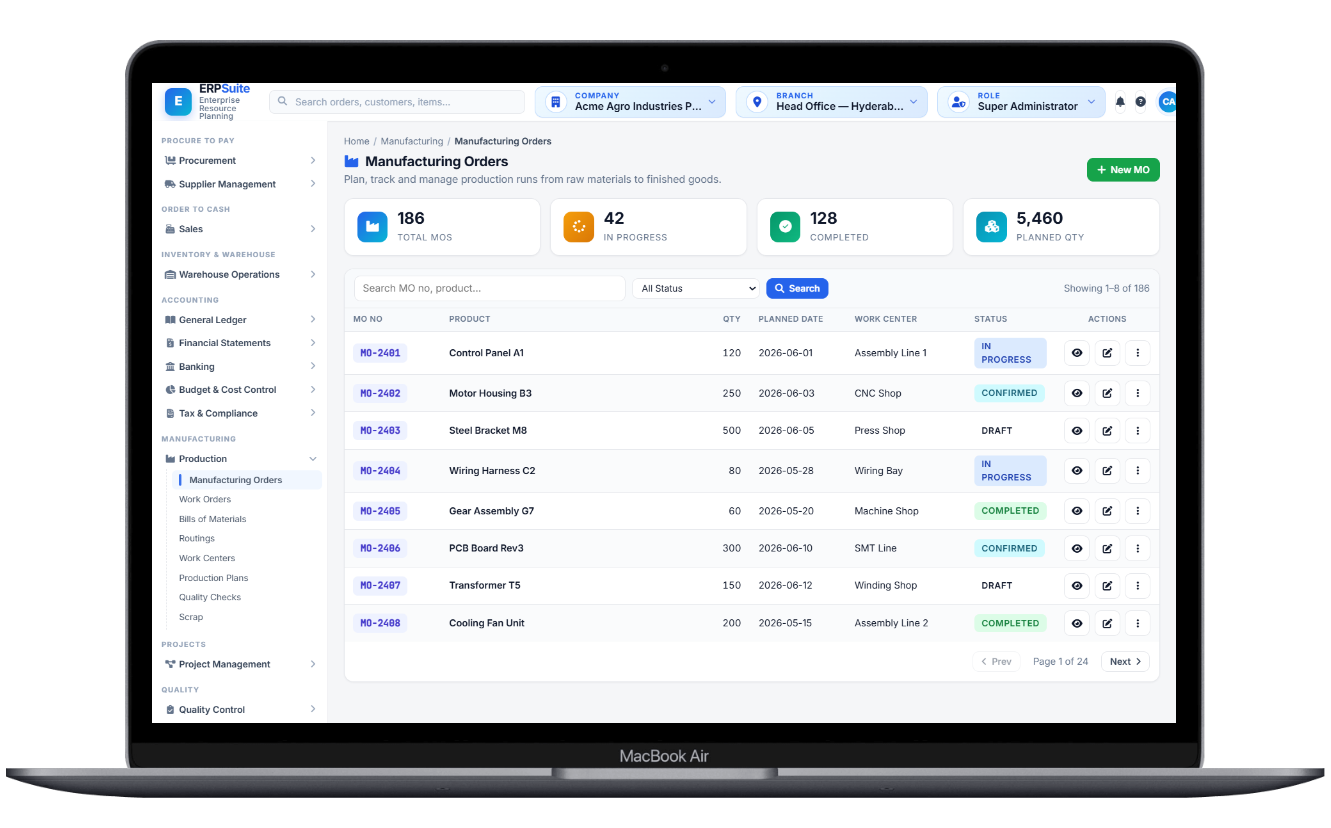
Production authorised against a bill of materials, reserving components and tracking output to completion.
Individual operations issued to a work centre with planned versus actual quantity and time.
Multi-level BOMs with component quantities, scrap allowance and versioning, so a design change does not corrupt history.
The operation sequence for a product with setup and run times per work centre, driving capacity and cost.
Machines and lines with capacity, cost rates and availability, forming the constraint that plans are built against.
Demand from sales orders and forecasts turned into a schedule, with material availability checked before release.
In-process inspection at defined stages, holding output that fails rather than letting it flow to finished stock.
Rejected and wasted material recorded against the order with its reason, so true yield and cost are known.
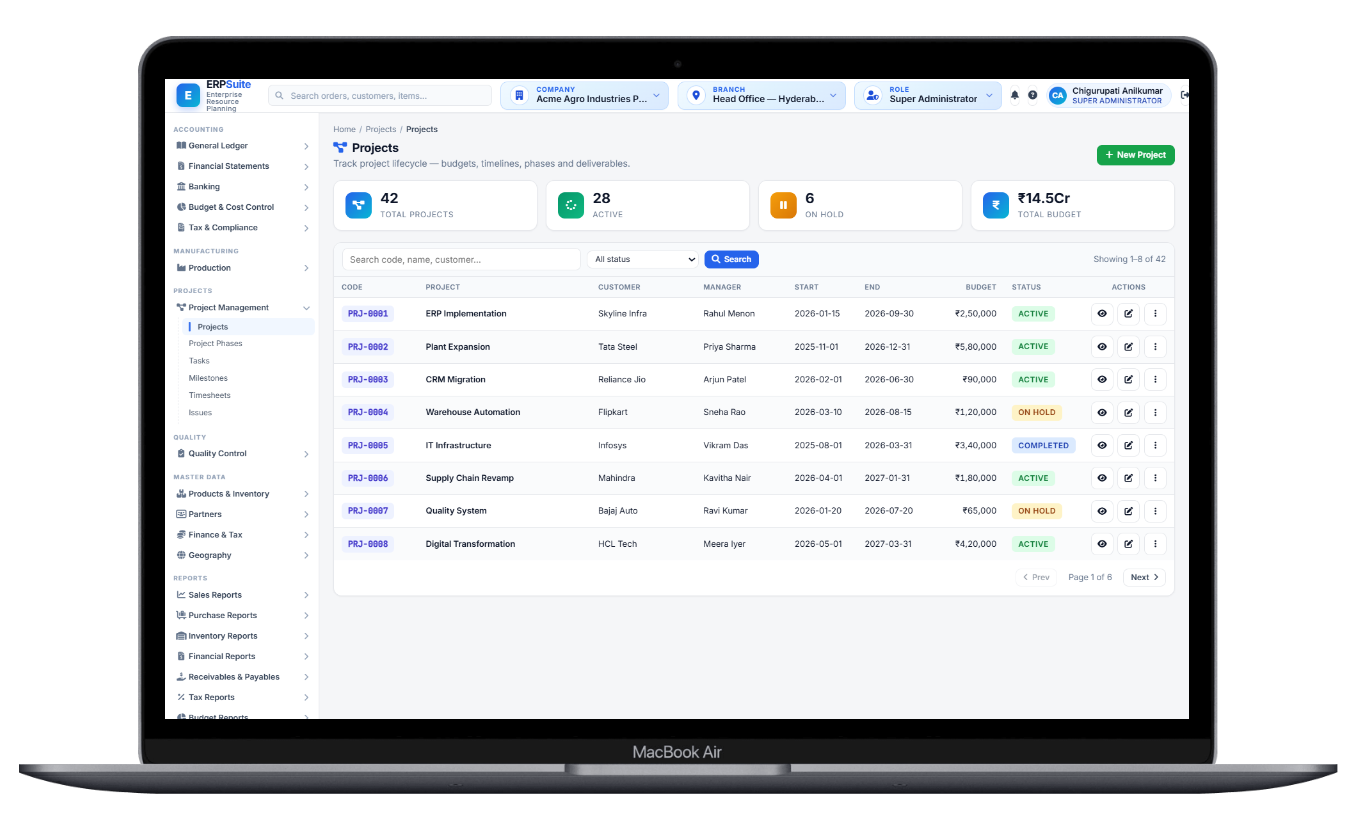
Project records with customer, budget, schedule and owner, capable of carrying their own cost and revenue.
Stage breakdown with dates and budget per phase, so progress is measured against a plan rather than a feeling.
Assignable work with effort estimates, dependencies and status rolling up to the phase.
Contractual checkpoints that can trigger billing, tying delivery to invoicing.
Hours booked to project and task, feeding both cost and any time-and-material billing.
Risks and blockers logged against a project with owner and resolution, kept beside the plan they threaten.
Inspection against defined parameters at goods receipt, in process or before dispatch, with accept, reject or rework outcomes.
The characteristics measured, their tolerances and where in the flow each check happens.
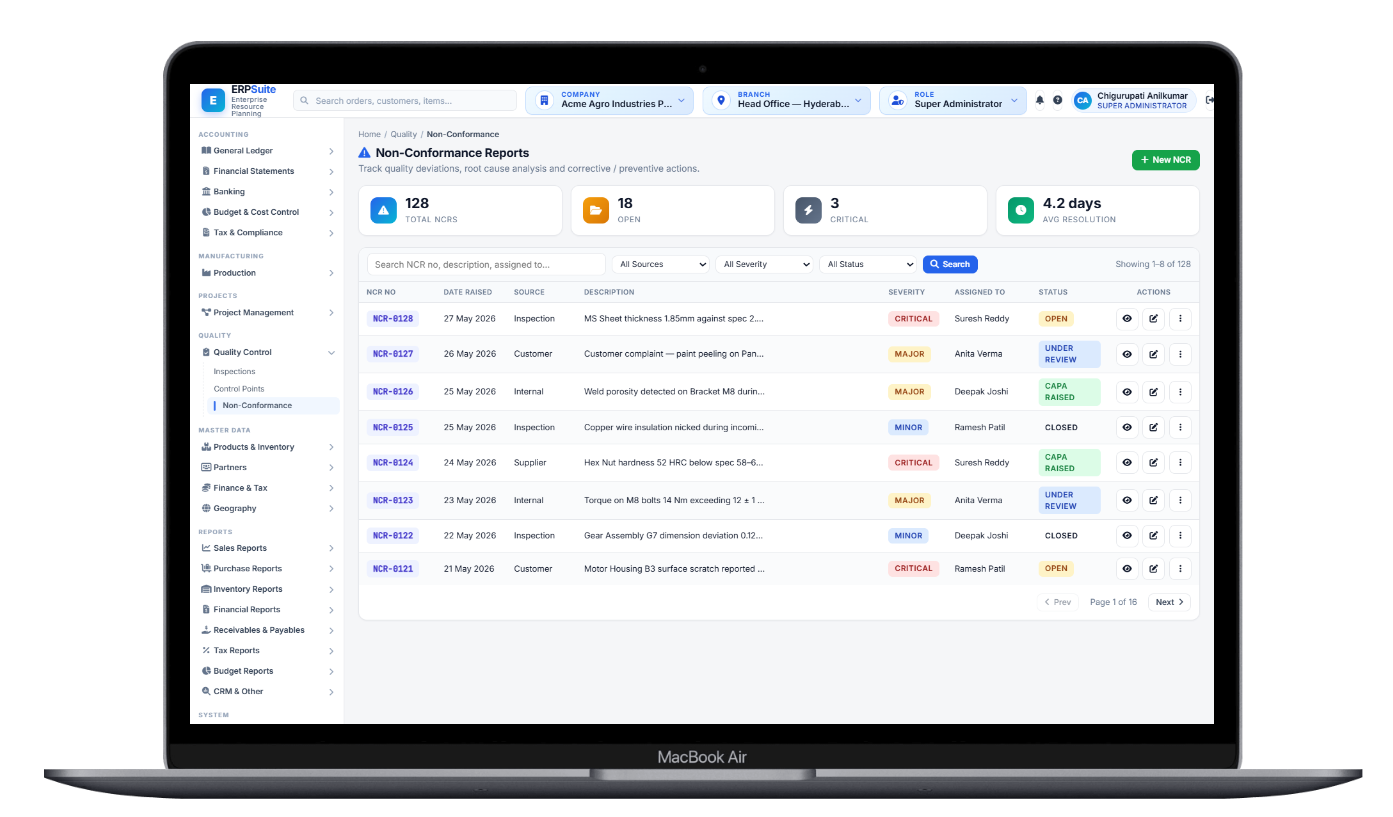
NCRs raised on a failure with root cause, disposition and corrective action tracked to closure.
The product master with type, category, tax class, valuation method, reorder parameters and batch or serial control.
Hierarchical grouping that drives default accounts, tax treatment and reporting rollups.
Statutory classification per item, so tax computation and GST returns are correct by construction.
Base and alternate units with conversion factors, allowing purchase in one unit and sale in another.
Storage facilities with their address, type and the ledger accounts their stock is valued into.
Bin-level structure within a warehouse — the granularity that makes putaway, picking and bin-wise stock possible.
Customer master with billing and shipping addresses, credit limit, payment terms, tax registration and price list.
Segmentation used for pricing, discounting and receivables reporting.
Supplier master with terms, tax details, bank information and the accounts their liabilities post to.
Grouping used for evaluation, spend analysis and approval routing.
The account structure every posting resolves to, with account type, group and control behaviour.
Tax rates and their components with the accounts they post to, applied by item, partner and place of supply.
Trading currencies with precision and symbol, enabling documents in a currency other than the books.
Dated rates per currency pair, used consistently for document conversion and revaluation.
Credit periods and instalment schedules that set the due date on every invoice and bill automatically.
The dimension that makes departmental profitability and budget control possible across every module.
A second level beneath the cost centre for finer allocation without multiplying the account structure.
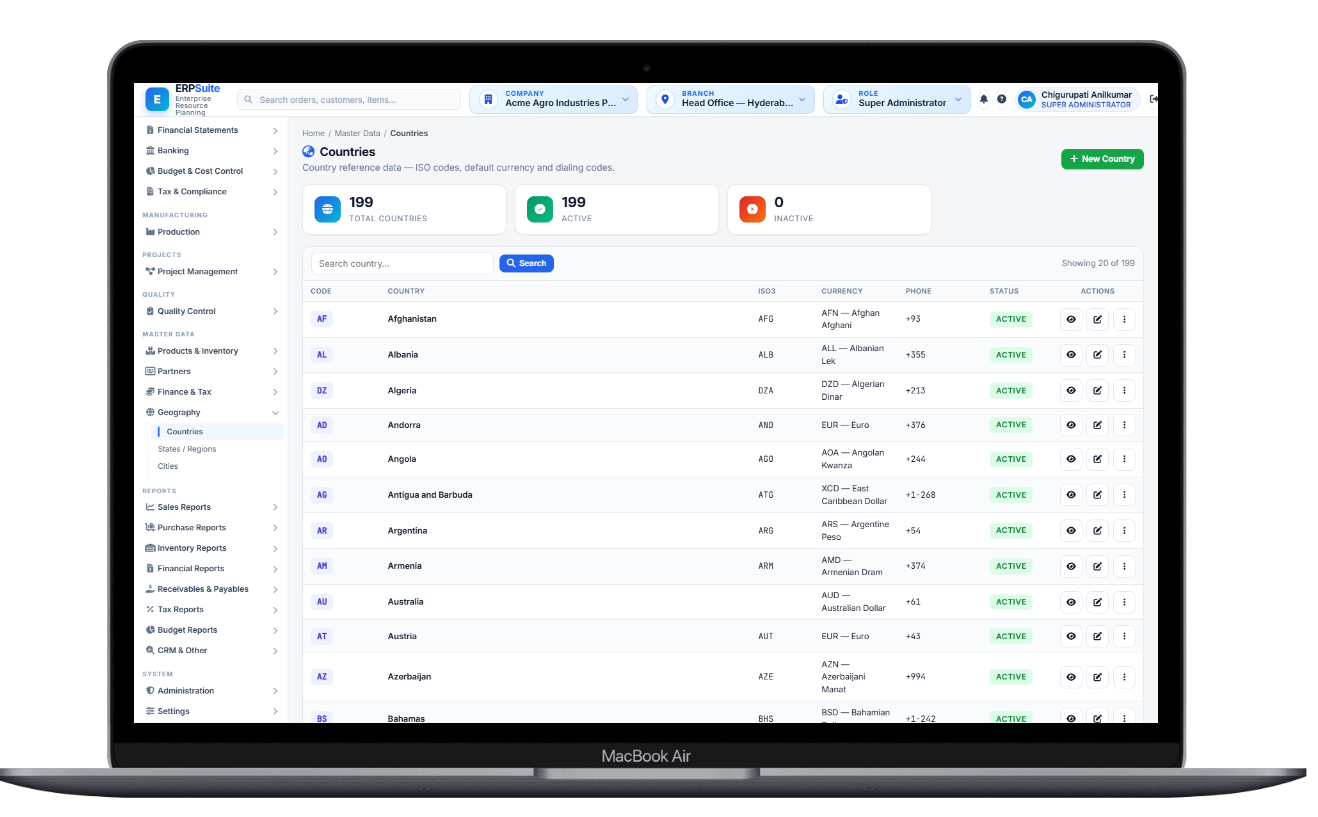
Country master driving tax jurisdiction, address format and statutory behaviour.
State and region records that determine place of supply and therefore the correct tax split.
City master used across partner addresses, delivery locations and territory reporting.
Five reports — sales register, sales by customer, sales by item, outstanding invoices and sales order tracking.
Five reports — purchase register, purchase by supplier, purchase by item, outstanding bills and purchase order tracking.
Five reports — stock summary, stock ledger, inventory ageing, reorder report and bin-wise stock.
Five reports — trial balance, general ledger, day book, cash flow and profitability.
Three reports — receivables, payables and ageing analysis, the pack a collections review actually runs on.
Three reports — GST summary, HSN summary and TDS report, generated from posted transactions rather than re-keyed.
Budget versus actual and the cost centre report, with variance traceable to the underlying entries.
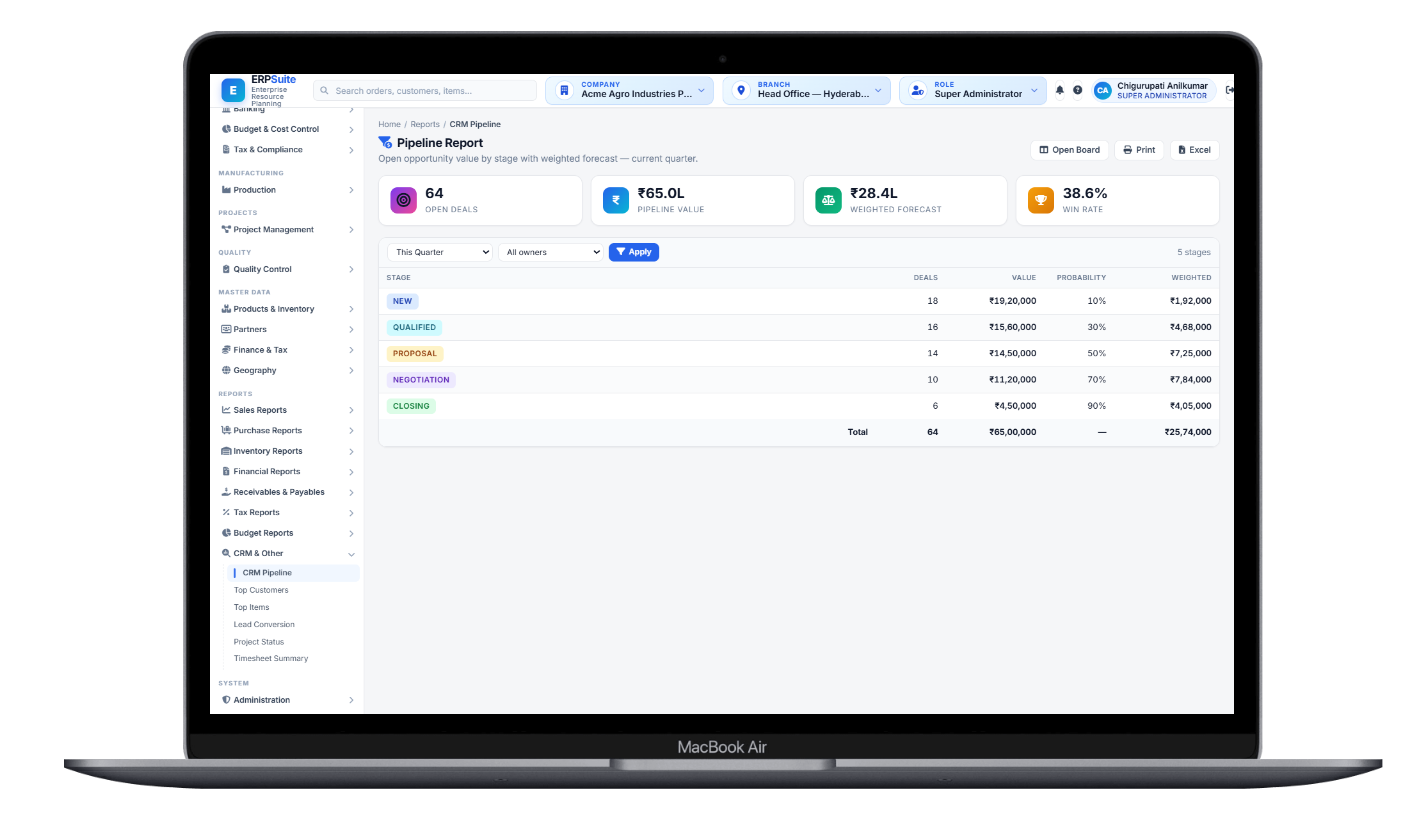
Six reports — CRM pipeline, top customers, top items, lead conversion, project status and timesheet summary.
Multi-tenant client records, each with its own data, users and configuration inside one deployment.
Multiple branches or legal entities with their own numbering, addresses and reporting, consolidated where required.
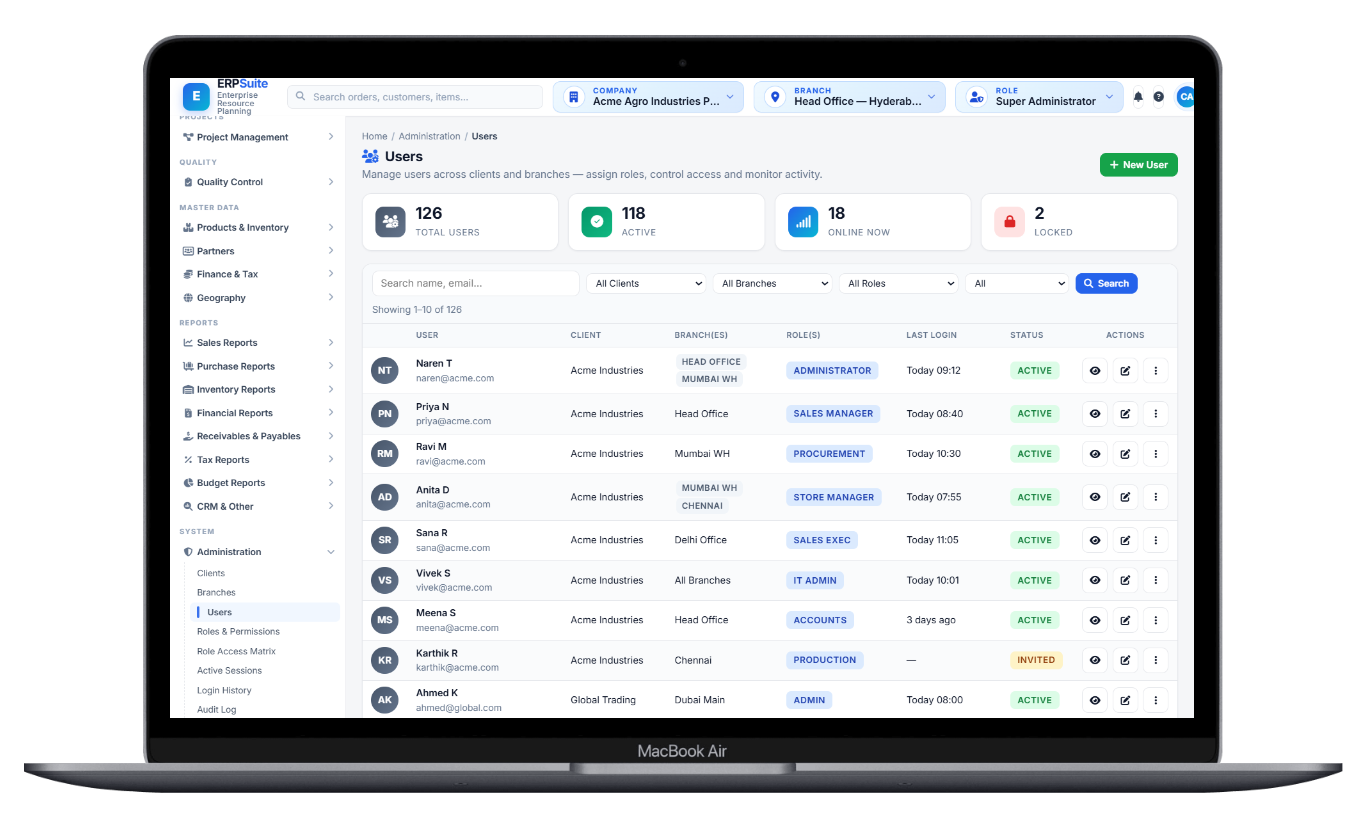
User accounts with their branch, role and status, provisioned and deactivated centrally.
Roles carrying module and action permissions, so access is granted by job rather than by person.
The whole permission grid on one screen — the fastest way to answer who can approve what.
Who is logged in right now and from where, with the ability to terminate a session.
Successful and failed sign-in attempts retained for security review.
Who changed what and when across every module — the record you produce when a figure is challenged.
Document numbering per type, branch and fiscal year, with prefixes and reset rules that satisfy statutory expectations.
Approval routing per document type and value threshold, so authority limits are enforced by the system.
Connections to external systems — eCommerce storefronts, carriers, banks and reporting tools — configured rather than coded.
Legal entity details, registrations and defaults that every document inherits.
Tax regime, registration numbers and the default treatment applied when a document does not override it.
Logo, colours and document templates so printed output carries your identity, not ours.
System-wide behaviour — date and number formats, decimals, defaults and feature toggles.
Per-user settings, password and notification preferences.
Real screens from the product — procurement, sales, inventory, manufacturing, accounting, projects, quality and administration, all sharing the same live data. Click any screen to view it full size.
"We go beyond software to ensure your ERP and WMS deliver measurable supply chain outcomes. With proven implementations across industries, our team blends strategy, automation and technical expertise. From affordable implementation services to managed operations, we focus on creating sustainable value at every stage. Partner with us to modernize inventory, accelerate fulfillment and scale your operations reliably."
Every business flow is connected end to end, with audit trails and configurable approvals at each step, so data moves once and stays consistent everywhere.
Demand, budgets and master data set the foundation
Requisition, PO, goods receipt and vendor bills
BOMs, work orders, quality checks and costing
Real-time inventory across warehouses and bins
Sales orders, delivery, invoicing and collection
Auto-posted ledgers, statements and reporting
We deliver ERP + WMS solutions across industries to streamline inventory, fulfillment and operations while ensuring compliance and cost control.
Optimize raw material flows, WIP tracking and finished-goods distribution with integrated ERP and warehouse workflows.
Improve throughput, routing and carrier integrations to lower logistics costs and improve on-time delivery.
Enable traceability, expiry and batch control across warehouse operations to meet strict regulatory requirements.
Support omnichannel fulfillment, returns processing and real-time inventory for superior customer experiences.
Manage materials, tools and asset lifecycles with inventory controls that reduce waste and improve project delivery.
Track perishable goods, cold-chain requirements and lot management from farm to consumer with precision.
Centralize procurement, asset tracking and inventory for campuses and institutional supply chains.
Support complex spare parts inventories, service parts planning and dealer replenishment with accuracy.
Securely manage medical supplies, equipment and traceability across multiple storage locations.
Automate procurement, time & expense allocation and equipment inventory for service teams.
Manage linen, consumables and procurement flows with accurate stock control and replenishment cycles.
Track critical spares, maintenance parts and inventory for resilient asset operations and predictive maintenance.
Streamline every warehouse workflow with a single mobile app built for efficiency, accuracy and speed — from the moment stock arrives to the moment it ships.
A single mobile app on Android and iOS handhelds covers the complete inbound-to-outbound cycle — receiving, putaway, picking and packing. One login, one barcode scanner, one live connection to the ERP, with no separate tools to switch between.
Scan inbound shipments against purchase orders, capture quantities, batch and expiry details, flag short or damaged stock, and post goods receipts straight into the ERP.
Direct stock to the right location with system-suggested bins, confirm every move by scan, and keep bin-level inventory accurate in real time.
Guide pickers with optimized routes, barcode scanning, and real-time inventory validation — reducing errors and speeding fulfillment.
Ensures correct packing with item validation, order grouping, auto-label printing, and carrier-ready documentation — minimizing mistakes and improving accuracy.
Orders flow in from every sales channel and shipments flow out to every carrier — automatically, in real time, with no re-keying. We have already delivered these integrations in production.
The ERP ships with a documented REST API, so connecting a storefront, marketplace or carrier we have not integrated before is straightforward — no core changes, no middleware licence. Authentication, rate limiting and retry handling are built in, and every exchange is logged for audit and troubleshooting.
Because enterprise-grade operations should be efficient and affordable. We make digital transformation pay off.
Forms and filters are dead UX. We embed an AI conversation layer into the apps we ship — so end users get answers, charts and actions in seconds, without learning your menu tree.
User: Show me top 10 customers by revenue this quarter
AI: Here are your top 10 — total Q3 revenue ₹4.82 Cr.
User: Draft a renewal offer letter for Priya Sharma
AI: Done — drafted using her grade revision and CTC, sent to HR review queue. Open draft →
Every page we build now ships with an optional AI assistant that reads your real data — sales, payroll, inventory, tickets — and answers in natural language. No new tab, no separate chatbot tool. Just a conversation, where the work happens.
Behind the scenes we also build with Claude — pairing it on architecture, code generation, test writing and migrations. The same AI that writes our code now lives inside your app to serve your customers.
Your user types — or speaks — a plain English question or instruction inside your app.
It understands the request, pulls exactly the right information, and stays within each person's access.
The answer lands as a chart, table, summary or one-click action — right inside your app, not in a side panel.
NDA-first · 30-minute strategy call · we ship a working prototype in two weeks
We protect your business data, source code, and intellectual property with legally binding agreements. Every ERP and warehouse project is secured under strict confidentiality protocols.
Every engagement starts with a signed NDA — before any discovery call, demo or data exchange. Your code, data and business logic stay confidential.
You own 100% of the source code and intellectual property. No vendor lock-in, ever.
We build trust through transparency, reliable delivery, and ongoing support that grows with you.
We deliver a working Proof of Concept before any financial commitment. See real results, validate the approach, and decide with confidence — no upfront charges, no lock-in contracts.
We build a functional prototype with your real business data in just 2-3 weeks — completely free of charge.
Get full source code and IP ownership of your project for an additional fee. No vendor lock-in — you control your software.
Not satisfied? Walk away with zero obligation. No penalty, no questions asked. The POC is yours to keep either way.
We don't believe in trapping clients. Flexible engagement models — fixed price, T&M, or dedicated team. You choose.
Ready to see your ERP come to life — for free?
Schedule Free ConsultationNo credit card required • No commitment • Response within 24 hours
Let us help you modernize your supply chain operations.
